
Introduction
Amazon (AMZN) has been one of the most frustrating stocks in big tech for the better part of seven years. It's one of the lesser Magnificent Seven, so to speak.
In absolute terms, long-term shareholders have done fine. In relative terms, it has been a slow bleed.
The chart below shows the ratio between AMZN and the NYSE FANG+ Index, which is an equal-weighted basket of ten heavily traded tech and tech-enabled giants that gets rebalanced every quarter. When the line falls, Amazon is losing to its own peer group.
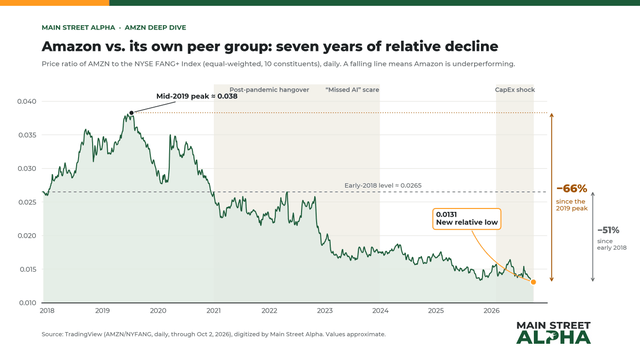
The line has been falling since mid-2019. The ratio peaked near 0.038 back then and now sits at 0.0131, the lowest reading on the entire chart. That's roughly two-thirds of relative performance gone since the peak, and about half since the start of 2018. All of these numbers are in the chart above.
There's just one problem with treating this as a verdict on the business, which is that the ratio hit its low in the same year AWS posted its fastest growth in 18 quarters(!!!).
As many of you know, I bought AMZN in September. Back then, I explained why it's a poor fit for my TOLL+M framework and why I bought it anyway as a way to own the funding side of the AI buildout. It's now my fourth-largest position, and I plan to buy a lot more of it in the months ahead.
In this article, I'll make the case that Amazon's laggard status is setting up to reverse. I'll explain why the gap opened, why the same bottlenecks that made chip stocks the trade of 2026 could start working in Amazon's favor, how the credit market fits in, why Amazon's retail margin is one of the most underrated levers in big tech, and what I think the stock is worth. I'll also cover the risks, because there are real ones.
This may be one of my favorite articles this month, even if I say so myself.
So, let's dive in!
AMZN: How The Gap Opened
As usual, the underperformance didn't come out of nowhere. I have to be honest when I say that a lot of it was earned.
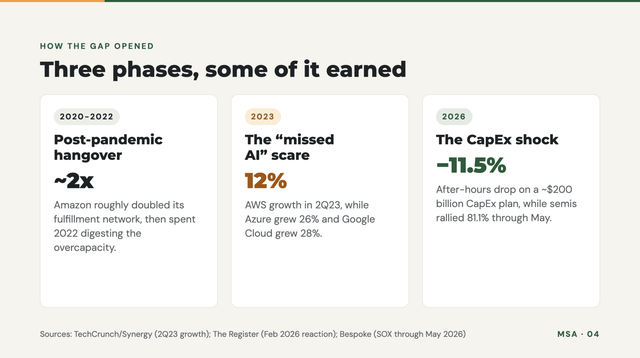
I believe it is fair to say that it happened in three phases.
Phase one was the post-pandemic hangover. Amazon roughly doubled its fulfillment network during the pandemic, then spent 2022 digesting overcapacity as online shopping normalized. Margins collapsed, the stock fell hard, and investors stopped trusting management's capital discipline.
Phase two was the AI scare. When the ChatGPT moment hit, AWS was decelerating. In 2Q23, AWS grew just 12%, while Microsoft's Azure grew 26% and Google Cloud grew 28%. The narrative basically wrote itself, which was that Amazon had "missed" AI.
If I had a dollar for every time I read that Amazon missed AI, I could probably fund a Trainium rack. Okay, a small piece of one.
Phase three was the CapEx shock. When Amazon told investors in February that it planned to spend roughly $200 billion in 2026, the stock fell as much as 11.5% after hours. And while Amazon was busy spending, 2026 became the year of semiconductors. The Philadelphia Semiconductor Index gained 81.1% through the end of May, its best start to a year on record.
The market rewarded the companies receiving the CapEx and punished the companies spending it. That has been going on for quite a while, and it makes sense, of course. You want to be on the receiving end of AI CapEx.
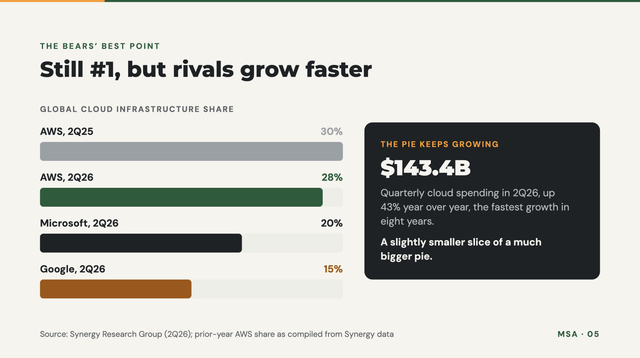
I also want to be honest about one thing the bears got right. AWS has been losing a bit of market share. According to Synergy Research, AWS held 28% of the global cloud infrastructure market in 2Q26, down from 30% a year earlier, even though the total market grew 43% to $143.4 billion. Microsoft (MSFT) and Google (GOOGL) are growing faster from smaller bases.
Now look at where the business is today:
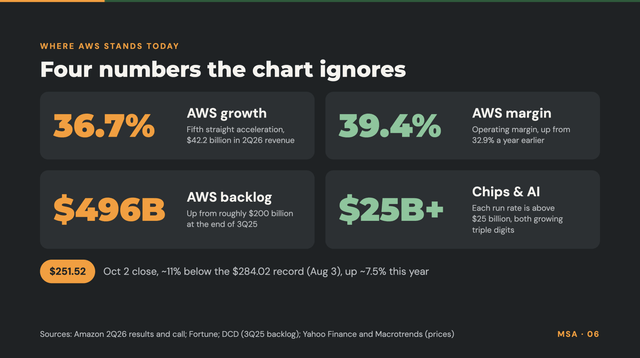
AWS revenue grew 36.7% to $42.2 billion in 2Q26, which was its fifth straight quarter of acceleration.
AWS operating margin came in at 39.4%, up from 32.9% a year earlier.
The AWS backlog (signed customer commitments not yet recognized as revenue) reached $496 billion. That's up from roughly $200 billion at the end of 3Q25. That's mind-blowing growth.
Amazon's custom chip business and its AI business each crossed a $25 billion annual revenue run rate, both growing at triple-digit rates.
Meanwhile, the stock closed in the low $250s in early October, roughly 11% below its August 3 record close of $284.02. That's nothing to write home about.
When a business accelerates while its relative chart makes new lows, one of two things is going on. Either the market sees something ugly coming, or it has been paying for the wrong layer of the AI trade.
I believe it's the second one.
Amazon Sits On The Other Side Of Every Chip Order
Here's the simplest way I can explain my thesis: one company's CapEx is another company's revenue.
When Amazon spends $220 billion on data centers, servers, chips, and networking gear, that money shows up as sales at chip designers, memory makers, and equipment suppliers. This is why the AI trade has been so kind to semis. They get paid upfront, while the buyers carry the risk.
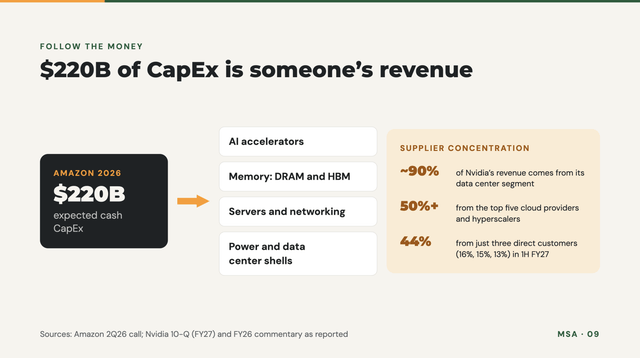
The concentration is remarkable. Nvidia (NVDA) generates roughly 90% of its revenue from its data center segment, and its CFO has said the top five cloud providers and hyperscalers account for a little over half of revenue. In the first half of its current fiscal year, three direct customers alone accounted for 16%, 15%, and 13% of revenue.
Now, here's the part I think is underappreciated.
Suppliers need CapEx growth. Buyers need CapEx to stop outrunning their cash flow. Those are very different things.
According to Goldman Sachs' September 24 outlook, hyperscaler CapEx will reach roughly $800 billion this year, $1.2 trillion in 2027, and $1.4 trillion in 2028. That sounds wildly bullish for suppliers. But look at the growth rates: from nearly 100% this year to 54% in 2027 and just 12% in 2028.
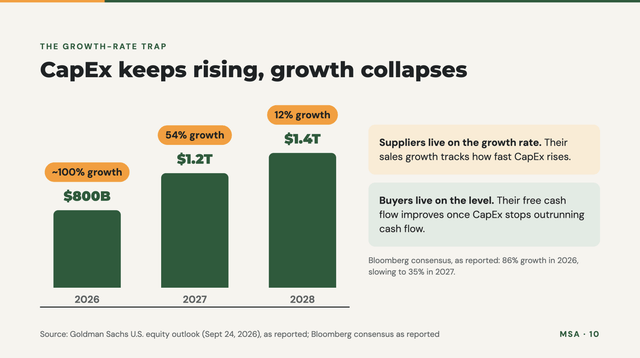
Bloomberg consensus, as reported, has 2026 as the cycle peak at 86% growth, slowing to 35% next year.
Let me make that concrete with simple numbers.
Imagine a hyperscaler spending $100 on CapEx. It grows spending by 86% to $186, then by 35% to $251.
For the supplier, sales growth just fell from 86% to 35%. If its stock was priced for the first number, it gets repriced, even though dollars kept rising.
For the buyer, incremental spending fell from $86 to $65, while revenue from everything already installed keeps compounding. Its free cash flow problem starts shrinking.
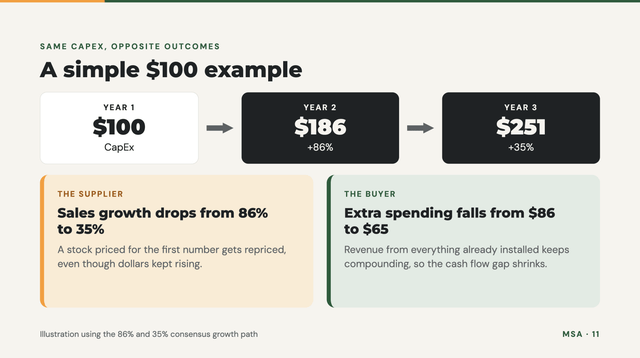
It's basically the same CapEx with different outcomes.
Goldman made a similar point: slowing CapEx growth benefits the hyperscalers, whose valuations have fallen to roughly ten-year lows.
Amazon also has more control over its spending than most people assume. On the 2Q26 call, Andy Jassy split the investment into two capital cycles. Data center shells are built about two years before they generate revenue, but they last 30 years or longer. Some may disagree with that, but the main point is that revenue is durable for many, many years.
Servers and networking gear are bought just a few months before they go into service, with strong visibility into customer demand. Servers break even in a little under three years, have useful lives of at least five to six years, and most AI capacity is now contracted on terms of at least five years.
"If the demand isn't there, we won't spend the capital." - Andy Jassy, Amazon CEO, 2Q26 earnings call
That's a buyer's option. A supplier doesn't get one. If orders slow, its revenue slows.
Sign in to leave a comment and join the discussion.
Sign Up Free