
Introduction
I wasn't planning on writing about Texas Pacific Land (TPL) this week.
Really. I wasn't - as much as I love talking about it.
Some of you have told me (very politely) that you've read enough about my favorite landowners for a while. I took that to heart. I had a nice, diversified lineup ready for the week. Not a single Permian surface acre in sight.
Then TPL issued a press release at 6 AM Eastern on a Monday, and here we are.
It is what it is. Apparently, the Permian doesn't care about my editorial calendar.
And to make things even funnier, last Thursday I published "A Real-Life Landman Plot: Diamondback, EagleRock And A $5 Billion Deal." I spent more than 3,600 words walking you through who could end up owning EagleRock Land (EROK). I came up with three scenarios: Deep Blue carving out the Midland water business, Diamondback Energy (FANG) buying Double Eagle's stake, or Viper Energy (VNOM) buying the whole thing.
The funny thing is that not one of my three scenarios had my own second-biggest holding as the buyer.
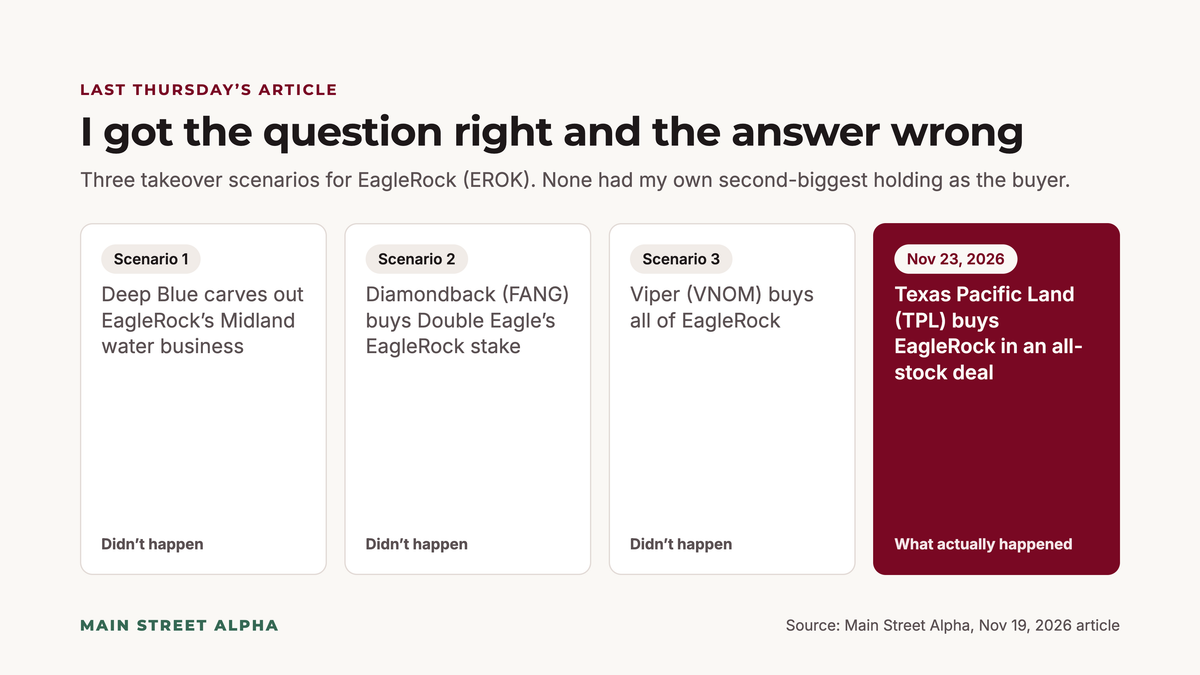
So, I got the question right and the answer wrong. I'll take it.
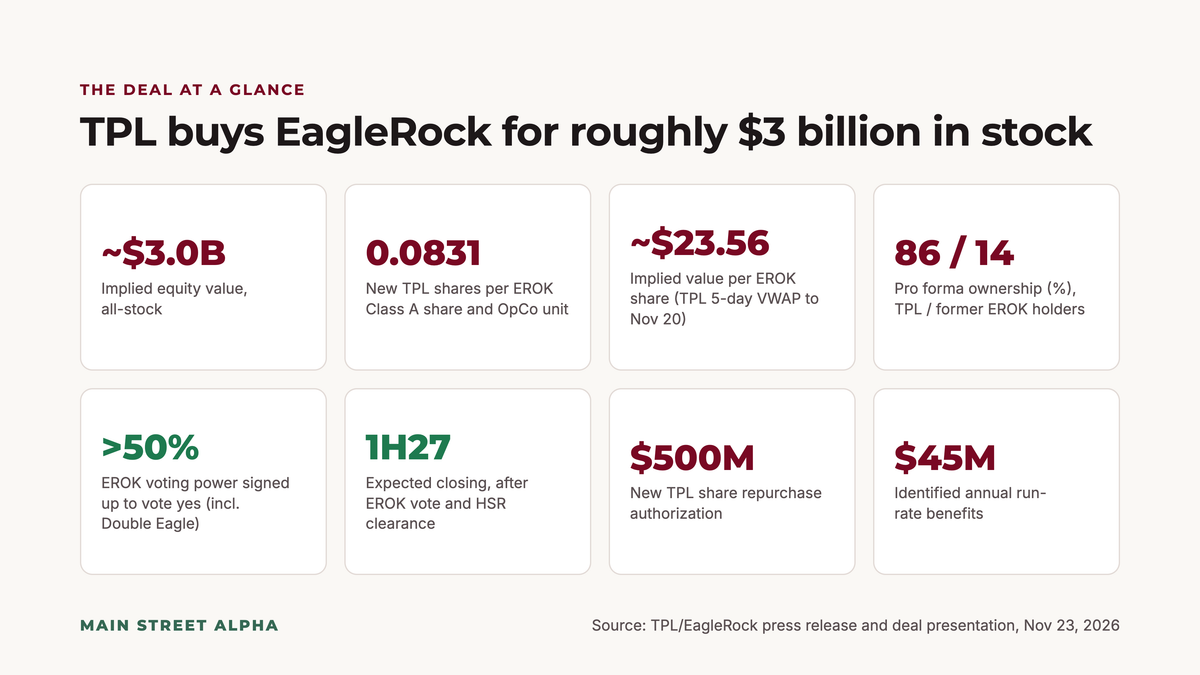
Today, TPL announced it will acquire EagleRock in an all-stock deal with an implied equity value of roughly $3.0 billion. EROK shares jumped double digits. TPL shares fell to a fresh 52-week low, as the market focused on the new shares TPL will issue.
In other words, we got a new layer of uncertainty.
And whenever there's uncertainty, we need to figure out if (and how) it can benefit us. Or maybe it even hurts my thesis.
I think the market is missing the bigger picture. In my view, this is one of the most important deals in TPL's modern history. It fills what management itself called a "hole" in TPL's map, and it turns an already strong water business into something much bigger.
So, in this article, I'll explain the deal in plain English, the three reasons it matters so much, what TPL paid (including the parts I don't love), why I believe TPL could be worth a lot more in five years, and what I'm doing with my own money.
So, as we have a lot on our plate today, let's dive right in!
The TPL-EagleRock Deal In Plain English
TPL will form a new holding company that will be renamed Texas Pacific Land Corporation at closing. Every TPL share turns into one share of the new company automatically. TPL shareholders don't need to do anything, and they don't get a vote.
EagleRock shareholders get a fixed 0.0831 shares of New TPL for every EROK Class A share. Pre-IPO owners who hold units in EagleRock's operating company (it used an "Up-C" structure) get the same ratio. Based on TPL's five-day volume-weighted average price as of November 20, that's roughly $23.56 per EROK share.
Here are the other key terms:
Ownership: TPL shareholders will own about 86% of the combined company, and former EagleRock holders about 14%.
Tax: The deal is intended to be tax-free for EagleRock holders.
Approvals: Both boards approved it unanimously. Holders with more than 50% of EagleRock's voting power, including Double Eagle, signed voting and support agreements. The vote is pretty much a formality.
Lock-up: Those holders agreed to a staggered lock-up that ends 12 months after closing.
Timing: Closing is expected in the first half of 2027, subject to antitrust clearance.
Buybacks: TPL raised its share repurchase authorization to $500 million.
What's the premium?
EROK closed at roughly $19.70 on Friday. Using the $23.56 figure, that's a premium of about 20%. Using TPL's Friday close of $267.44, the implied value is $22.22 (0.0831 x $267.44), a premium closer to 13%. Because the ratio is fixed, the value moves with TPL's share price.
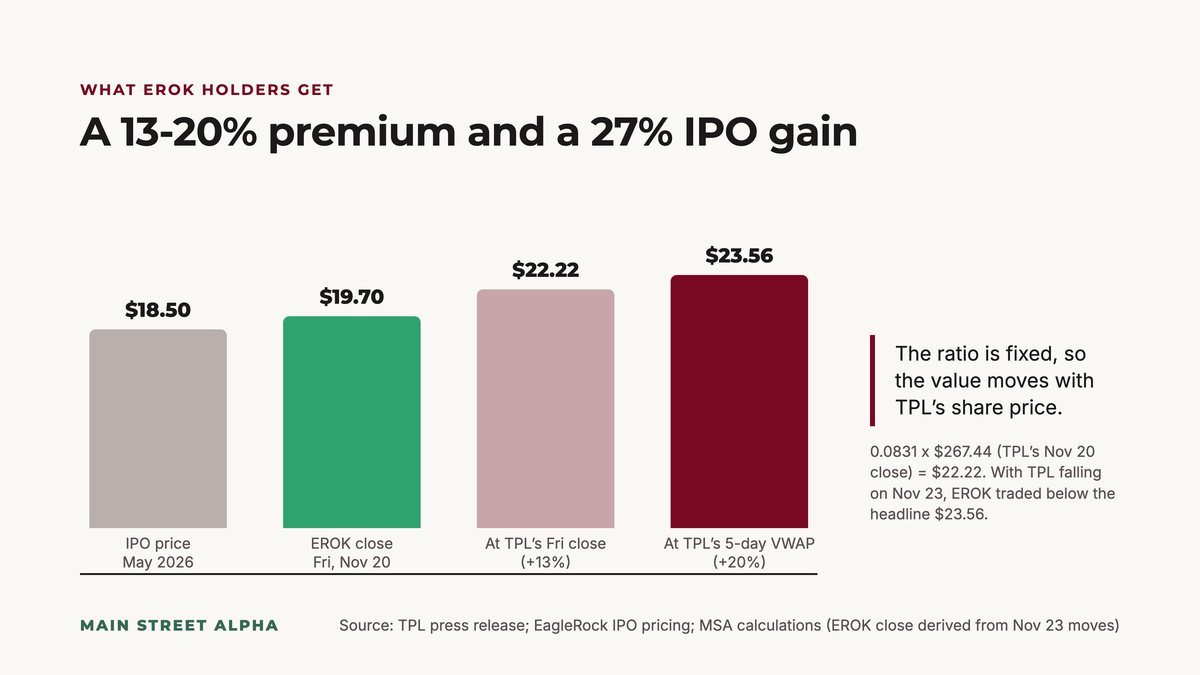
Either way, EROK holders who bought the IPO at $18.50 in May are walking away with a nice gain after just six months.
Reason One: TPL Finally Gets A Real Seat In New Mexico
If you look at a map of TPL's land, you'll notice something.
TPL owns roughly 896,000 surface acres in West Texas, a land position that goes back to an 1888 railroad bankruptcy. But it stops at the state line.
That matters because one of the busiest parts of the entire Permian is just across that line.
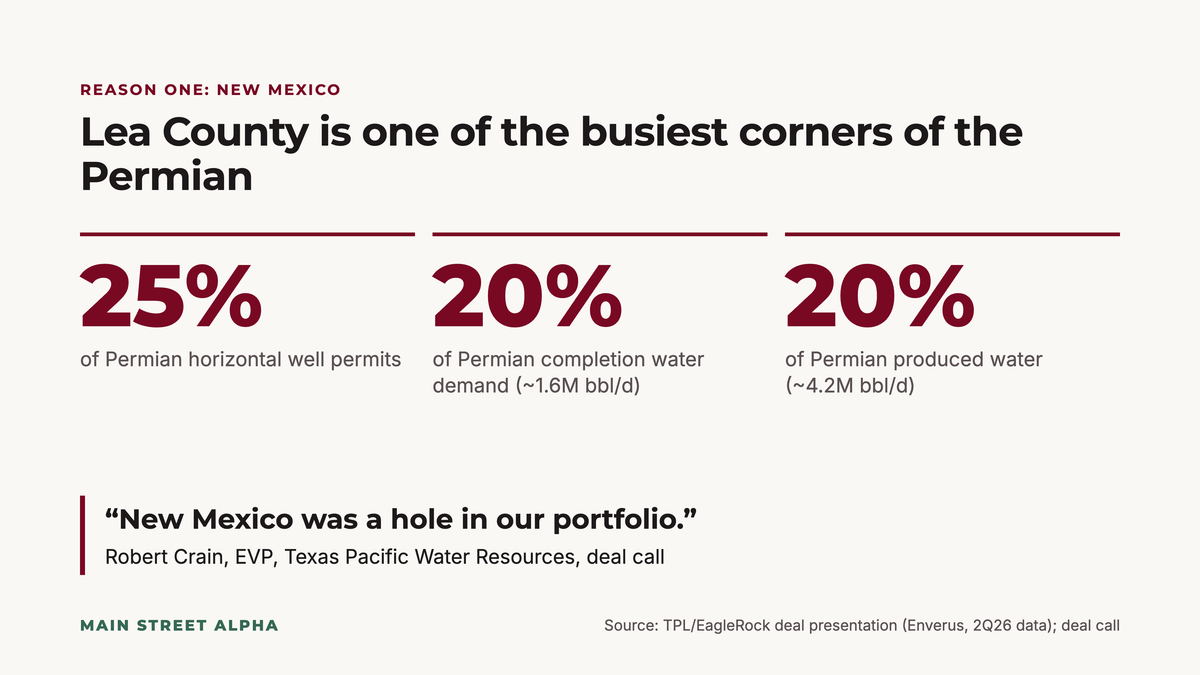
EagleRock brings roughly 59,000 owned acres, mainly in Lea County, New Mexico, plus roughly 185,000 acres of state and federal grazing leases. Now, look at what Lea County means to the Permian:
About 25% of all Permian horizontal well permits.
About 20% of Permian completion water demand (roughly 1.6 million barrels per day).
About 20% of Permian produced water (roughly 4.2 million barrels per day).
Think about that for a second.
Here's the map, by the way:
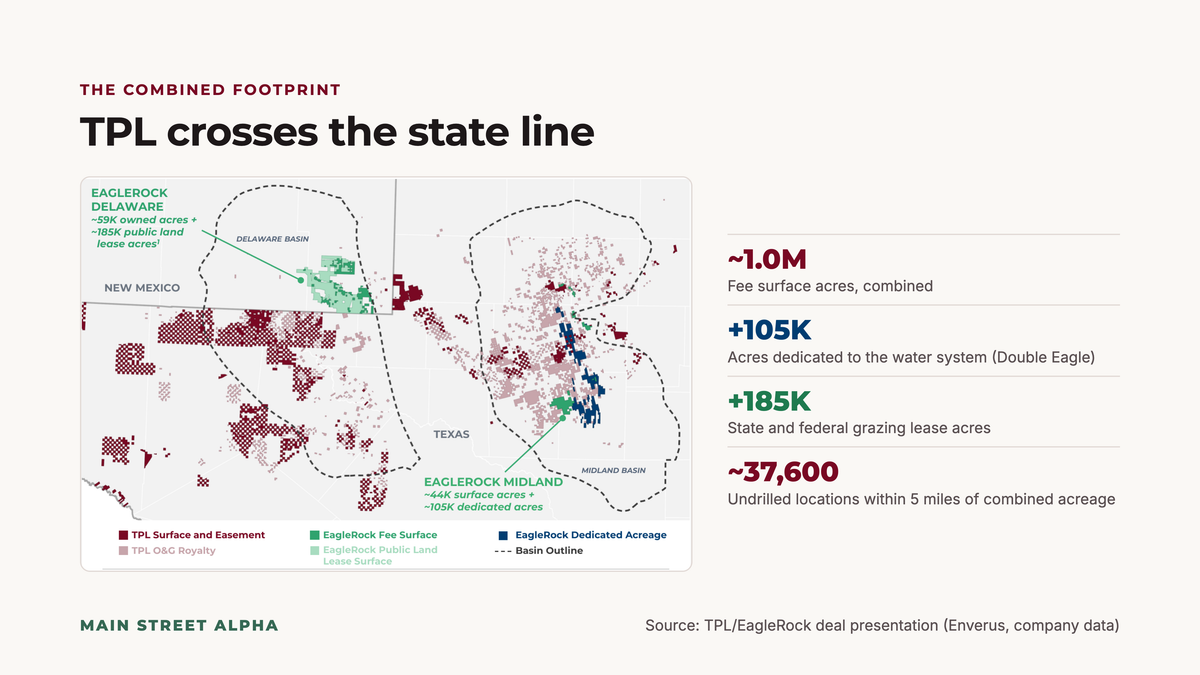
TPL is a water and land company. Lea County is a giant water market. And until today, TPL had no meaningful surface position there.
Robert Crain, who runs Texas Pacific Water Resources, said it best on the deal call:
New Mexico was a hole in our portfolio.
You need to know that in the water business, distance kills economics. Water is heavy, and moving it long distances eats into margins quickly. The same applies to so many other commodities - the further you are from your own land and pipes, the harder it is to compete.
EagleRock's New Mexico assets include more than 140,000 barrels per day of non-potable water access (water that isn't fit for drinking, which oil companies use for fracking) and roughly 100,000 barrels per day of Texas-to-New Mexico pipeline capacity. The deal increases TPL's non-potable water access in the northern Delaware Basin by 25%.
What I'm getting at is simple. With these acres, TPL now has direct access to a market it could only serve from a distance before.
Reason Two: The Double Eagle Connection (And Why Diamondback Is In This Story)
This is the part that ties back to last week's article.
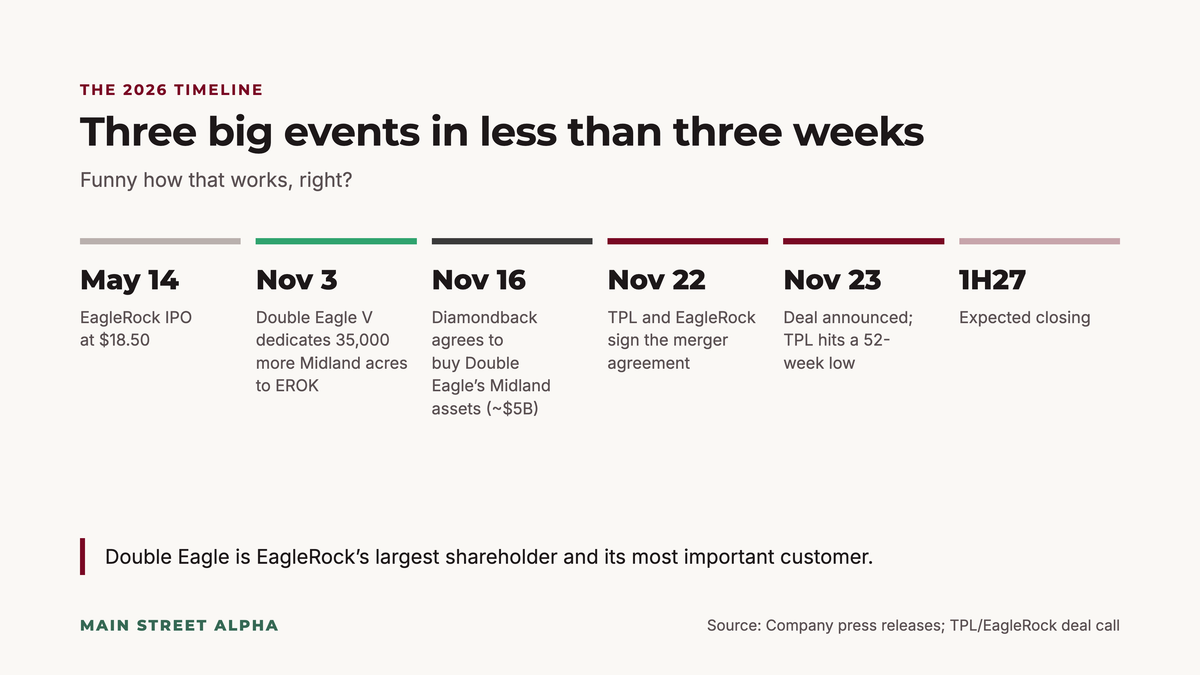
As many of you know, Double Eagle is EagleRock's largest shareholder and its most important customer. It has dedicated more than 100,000 Midland Basin acres to EagleRock's water system under a 10-year agreement. The latest piece was a 35,000-acre dedication from Double Eagle V, announced on November 3.
On November 16, Diamondback agreed to buy a big chunk of Double Eagle's Midland assets for roughly $5 billion.
On November 22, TPL and EagleRock signed their merger agreement.
Three major events in less than three weeks. Funny how that works, right?
Double Eagle's co-CEO John Sellers joined the TPL call and summed up the relationship:
Our development program in the Midland Basin depends on EagleRock's acreage and water system.
In last week's article, I said that a company with a balance sheet that doesn't like paying a toll has two options: live with it or buy the toll booth.
Someone did buy the toll booth. It just wasn't Diamondback. It was TPL.
TPL acknowledged that Diamondback has agreed to buy portions of the Double Eagle-dedicated acreage and said it expects to work with Diamondback after that deal closes. Diamondback is no stranger to TPL, as it already operates on parts of TPL's royalty acreage.
Here's what TPL gets in the Midland Basin:
Roughly 44,000 surface acres, increasing TPL's Midland surface acreage by nearly 40%.
Roughly 105,000 dedicated acres (EagleRock doesn't own this land, but it serves the water needs of the development on it).
About 220,000 barrels per day of produced water recycling capacity, a 110% pro forma increase.
A water supply contract with Double Eagle that started at roughly 180,000 barrels per day in July 2026, ahead of schedule.
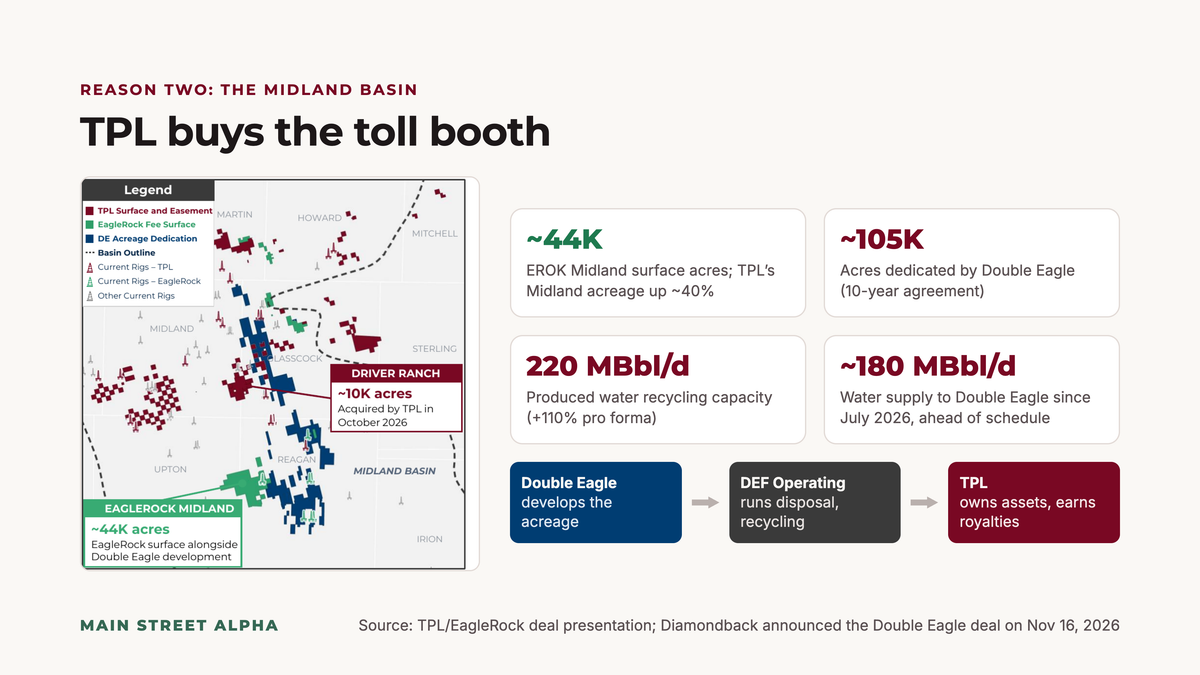
The structure is very TPL-friendly. TPL will own the water assets and operate the source water system. A Double Eagle affiliate operates the recycling and disposal systems, and TPL earns royalties on those volumes. That's right up TPL's alley, as it gets paid per barrel without operating disposal wells.
Reason Three: TPL's Water Business Gets A Lot Bigger
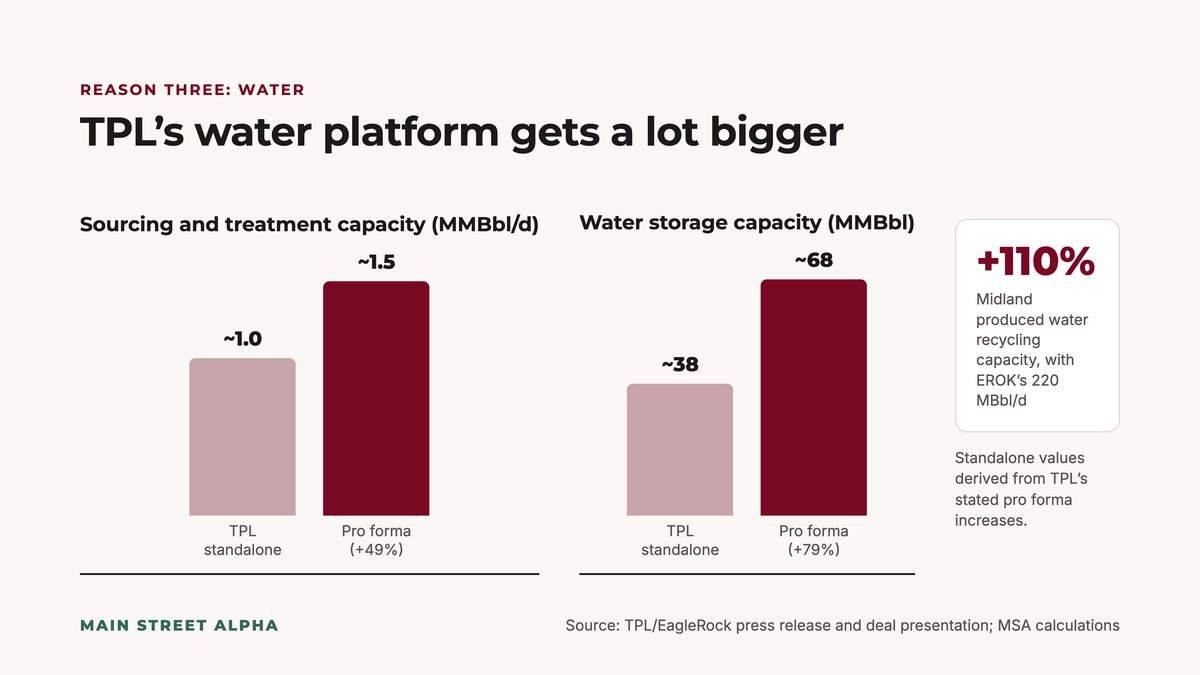
After the deal, TPL expects to have:
About 1.5 million barrels per day of combined water sourcing and produced water treatment capacity, a 49% increase.
About 68 million barrels of water storage capacity, a 79% increase.
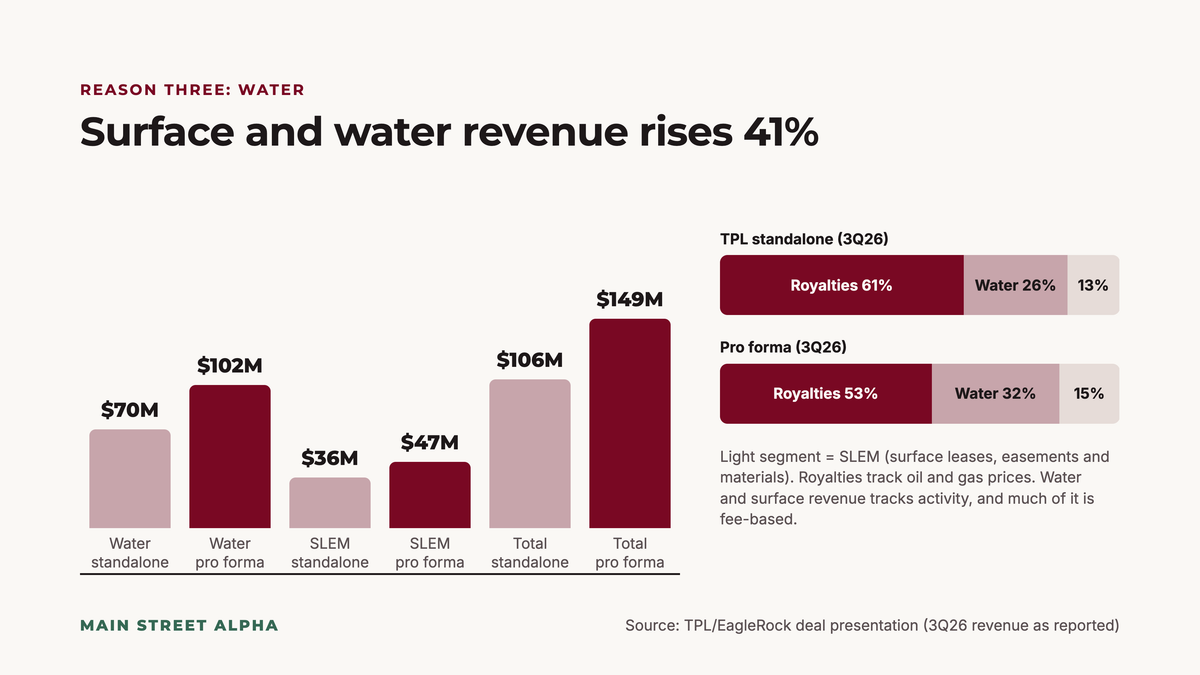
Using 3Q26 numbers, TPL's surface and water revenue rises from $106 million to $149 million on a pro forma basis (+41%). As a result, oil and gas royalties drop from 61% of revenue to 53%.
Why does that matter?
Royalties are tied directly to oil and gas prices. Water and surface revenue is tied to activity (drilling, completions, pipelines, power lines), and much of it is fee-based. The combined company is still a Permian business, but it's less of a pure commodity bet. Personally, I like that a lot, as I want energy investments with as little direct commodity exposure as possible.
And there's a long-term angle. Produced water is one of the biggest problems in the Permian, as roughly four barrels of it come up with every barrel of oil, and disposal capacity is getting tighter. I could write 10,000 words on this alone.
As some of you may know, TPL is working on freeze desalination, with a 10,000-barrel-per-day facility in Orla, Texas, and plans for a commercial-scale facility of about 100,000 barrels per day in 2027 and beyond. The deal gives it access to roughly 3 million barrels per day of produced water for recycling in New Mexico alone.
Now, you may be asking why these assets should be worth more inside TPL?
Its track record is the reason. From 2017 through 2025, TPL invested $229 million in water CapEx and $213 million in surface and easement acquisitions while generating more than $800 million in cumulative water segment cash flow.
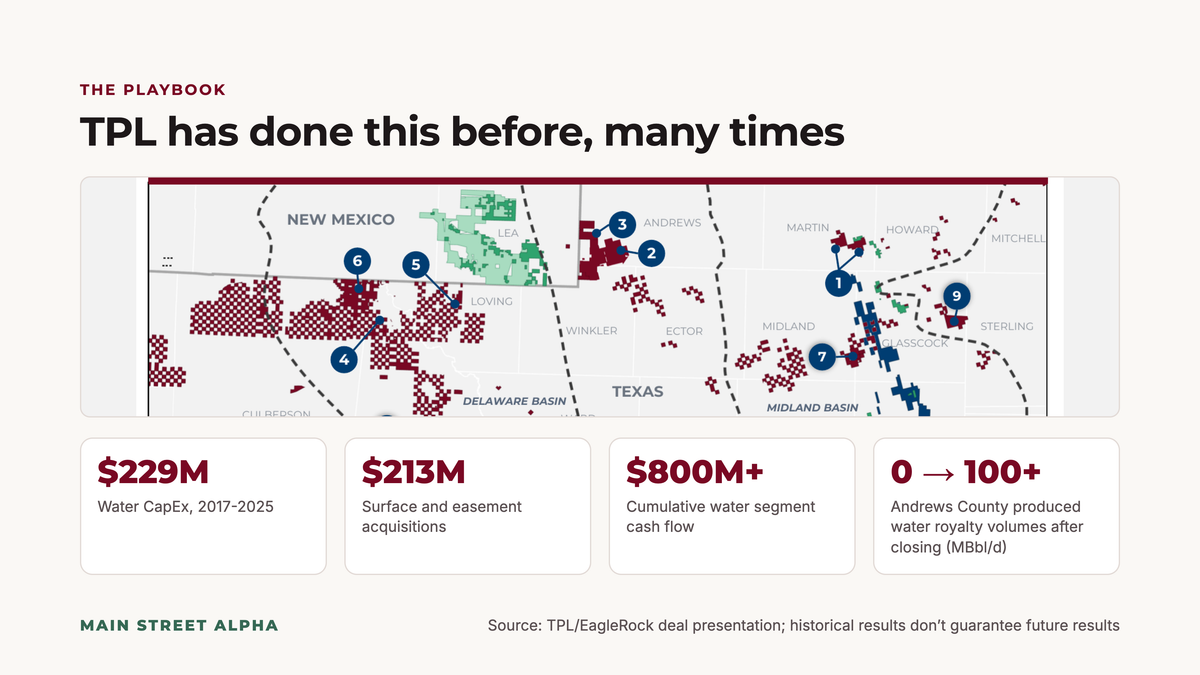
In Andrews County, produced water royalty volumes on acquired land went from zero to more than 100,000 barrels per day after closing. That's the playbook it now brings to EagleRock's acres.
The Numbers: Synergies, Accretion And What TPL Paid
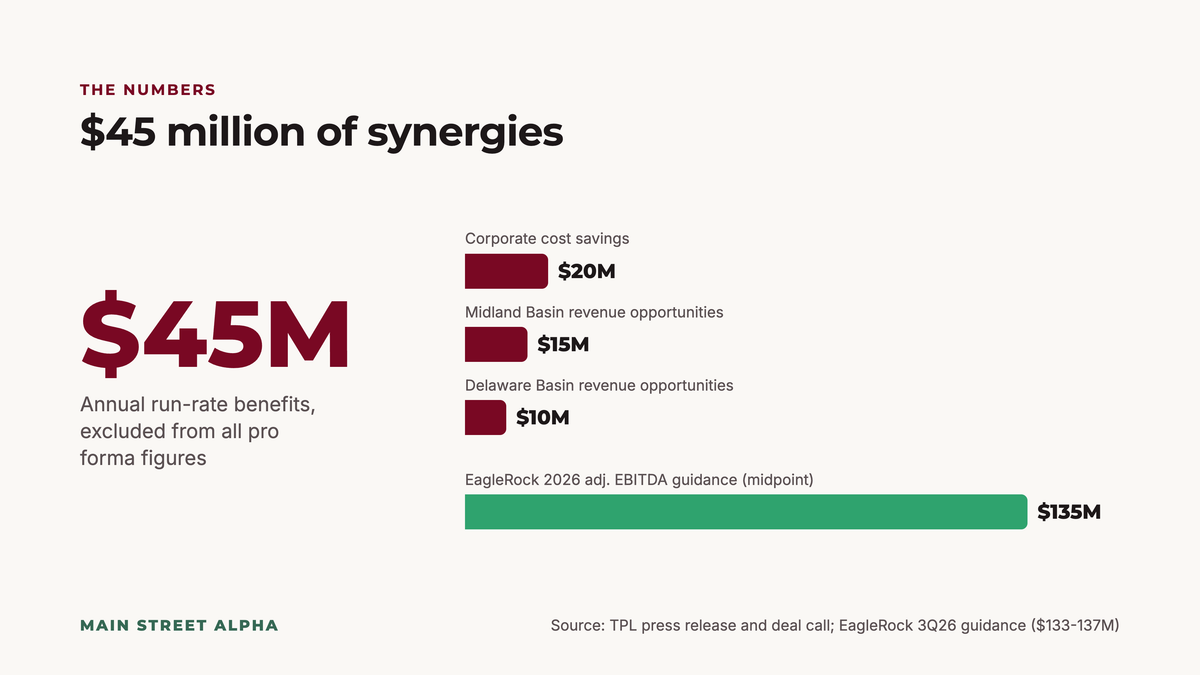
Management expects roughly $45 million in annual run-rate benefits:
$20 million of corporate cost savings.
$15 million of Midland Basin revenue opportunities.
$10 million of Delaware Basin revenue opportunities.
EagleRock guided for $133 million to $137 million in 2026 adjusted EBITDA. So, the synergies are equal to roughly a third of its EBITDA. And TPL excluded them from all pro forma numbers, so they're pure upside.
The rest of the pro forma profile is classic TPL: an 83% adjusted EBITDA margin, a 60% free cash flow margin, CapEx of about 6% of EBITDA, and a net cash balance sheet. As CFO Chris Steddum put it, "TPL is not incurring new debt to finance the transaction."
Now, what did TPL pay? Here's my back-of-the-envelope math:
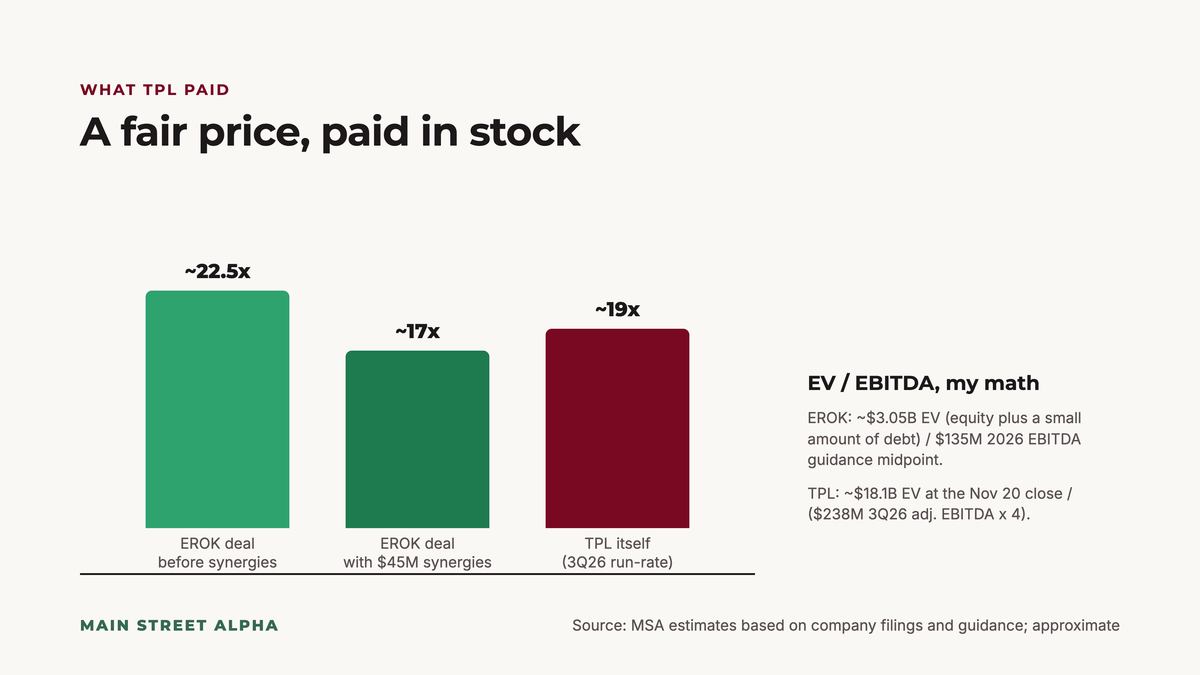
EagleRock's enterprise value is roughly $3.05 billion (equity plus a small amount of debt).
Against $135 million in 2026 EBITDA, that's roughly 22.5x.
Including the full $45 million in synergies, it falls to roughly 17x.
For context, TPL trades at roughly 19x its 3Q26 run-rate EBITDA after the recent sell-off. So, TPL paid a slightly higher multiple than its own on day one, and a much lower one if it delivers the synergies.
What about accretion?
On a 2026 YTD basis, it doesn't look accretive yet. Pro forma free cash flow is about 13% higher than TPL's standalone number, while the share count rises by about 16% (roughly 11.2 million new shares on top of 69 million).
But on a 3Q26 run-rate basis, it flips. TPL generated $170 million in free cash flow in 3Q26, and EagleRock generated $31.8 million. That's roughly 19% more free cash flow for roughly 16% more shares.
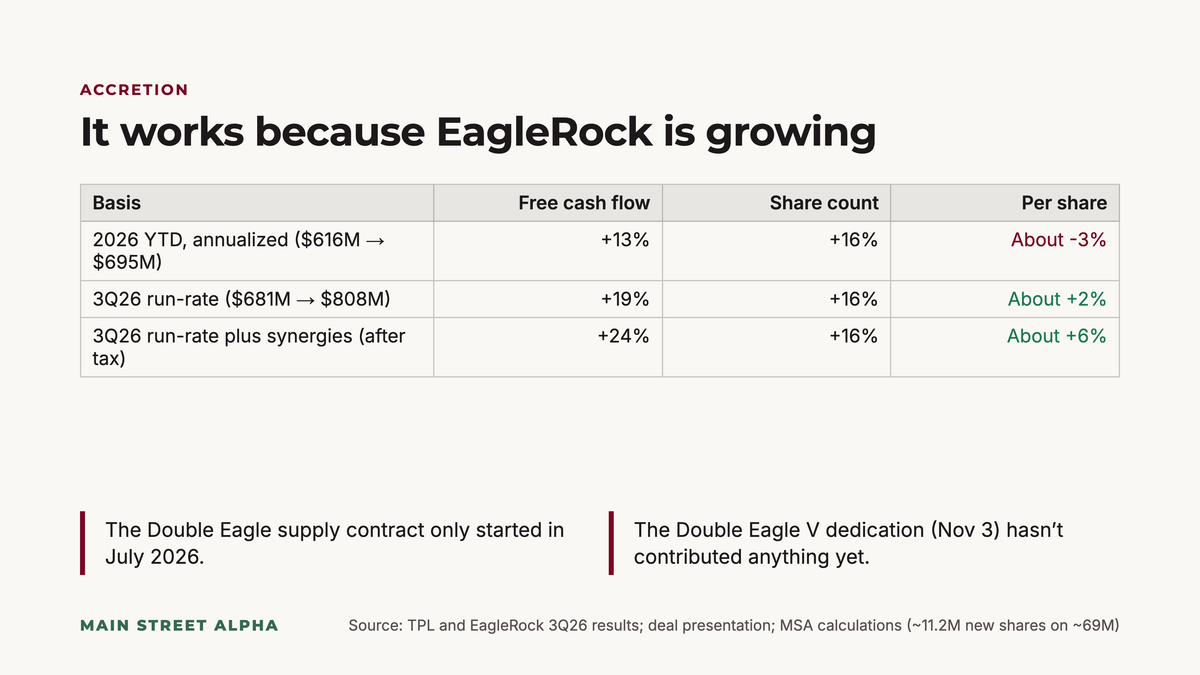
The difference is growth. The Double Eagle supply contract only started in July, and the Double Eagle V dedication hasn't contributed anything yet. TPL is buying a business that is still ramping up, which is why it says the deal is accretive to 2027 free cash flow per share before synergies.
The Part I Don't Love
There are two things I don't love about this deal.
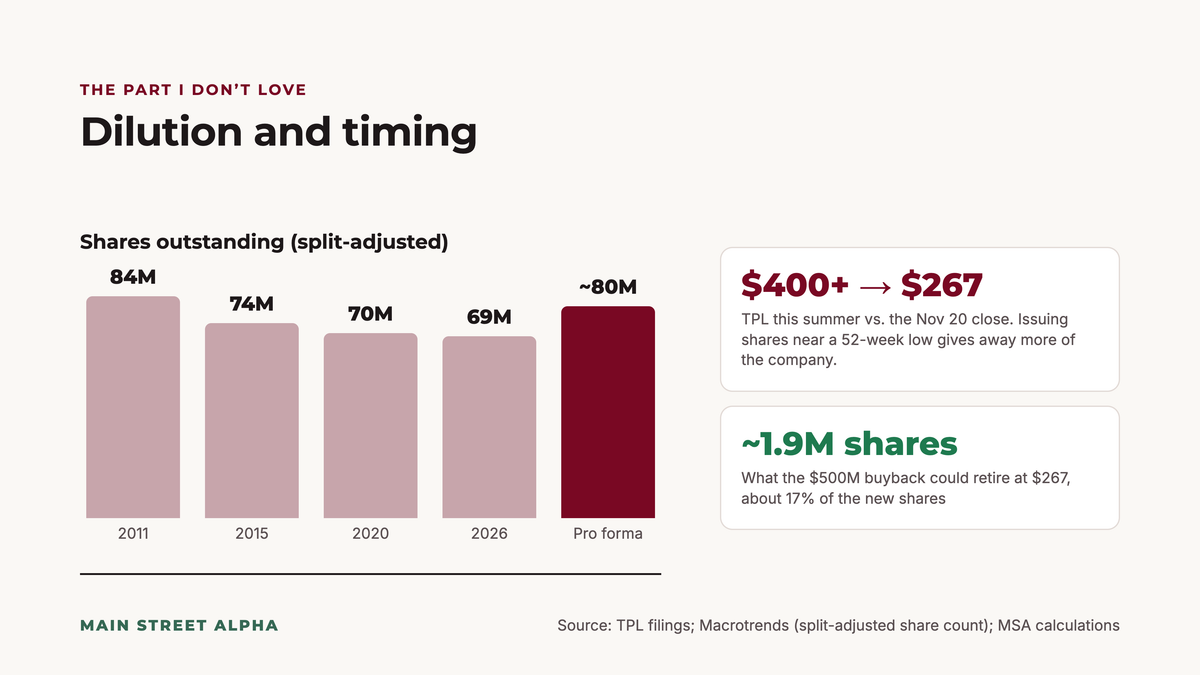
First, dilution. TPL's share count (adjusted for its recent 3-for-1 split) fell from roughly 84 million in 2011 to roughly 69 million today. This deal reverses about three-quarters of those buybacks in one go. For a company known as a buyback machine, that's a big decision.
However, I believe this is caused by Eagle Rock. I expect that they would not have done the deal for cash. I don't have sources to back it up, but if I were Eagle Rock, I would have pushed for an all-stock deal.
Second, timing. TPL traded above $400 as recently as this summer. It closed at $267.44 on Friday and fell further today. If you believe (like I do) that TPL is worth a lot more, issuing shares near a 52-week low means giving away more of the company than you would have six months ago.
In fairness, the ratio was set off a five-day average, the deal keeps the balance sheet debt-free, and EagleRock's owners chose TPL stock over cash, which is a vote of confidence. At $267, the new $500 million buyback authorization could retire roughly 1.9 million shares, about 17% of the new shares.
So, would I have preferred a deal at $400 per TPL share? Absolutely. Do I think that makes it a bad deal? Absolutely not.
TPL Valuation: Why I Believe The Stock Could Be Worth A Lot More In Five Years
Now, let's talk about what really matters for TPL shareholders.
Sign in to leave a comment and join the discussion.
Sign Up Free