

The Anthropic IPO Deep Dive (And Tokenomics 6): 45X Growth In Six Quarters, 85,000 Businesses' Receipts, The Cheapest Multiple In Its History... And Why ZEUS Is Buying 1% On Day One 🤯😉🤔
Full disclosure, first line, not last: GNG's research desk runs on Claude, which is made by Anthropic, the company this report is about. So I had the desk grade Anthropic HARDER, not softer. The desk digs through the filings and runs the numbers. The thesis, the calls, and the ZEUS plan are mine. ZEUS's Anthropic position is sized by the same published gates every other holding faces, and every gate is a number you can check. Numbers are as of Tuesday, November 17, 2026, the day before the deal prices, and each has its source right next to it. ANT prices Wednesday night and starts trading Thursday... and whatever the final price turns out to be, the price ladder near the end shows exactly what it means.
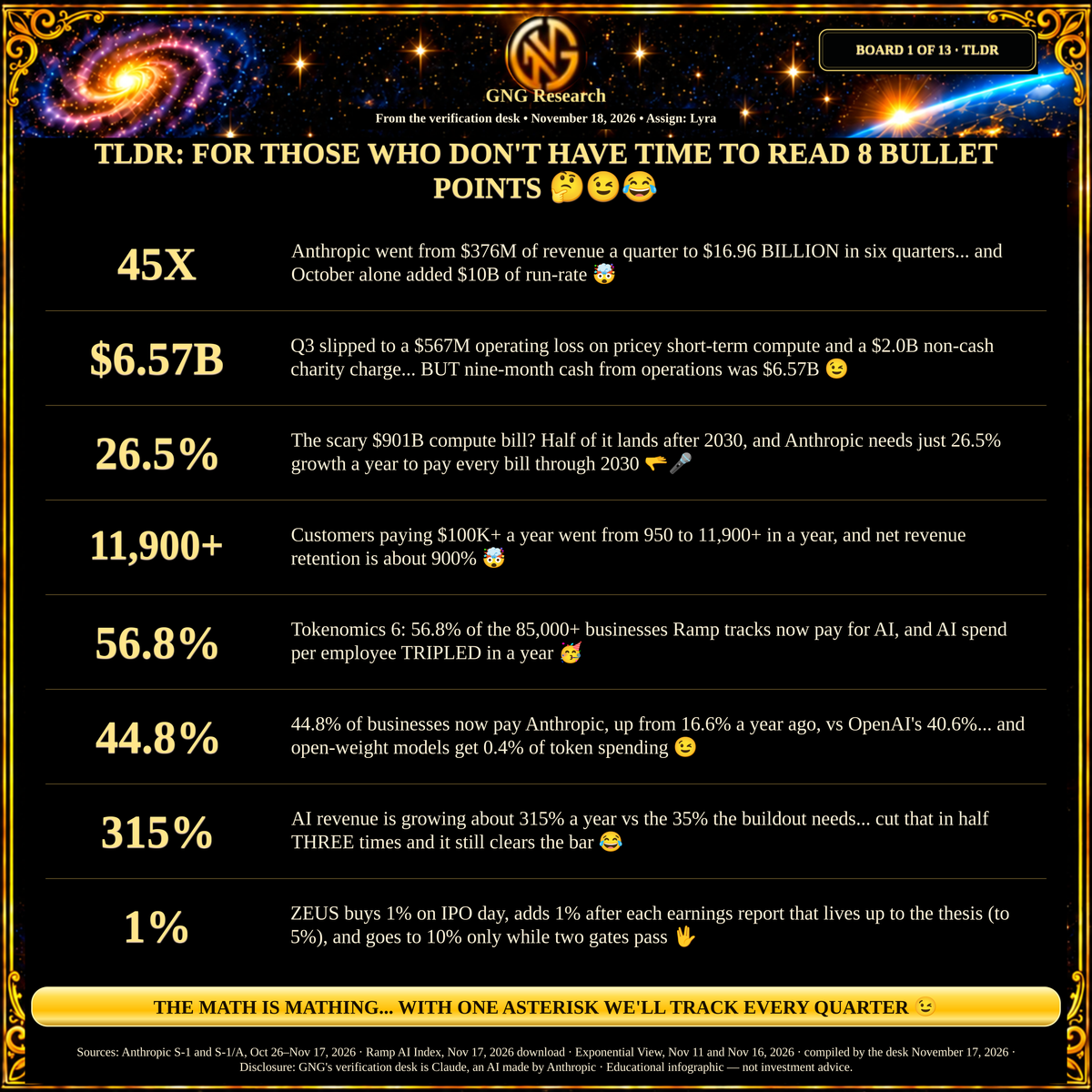
Anthropic went from $376M of revenue a quarter to $16.96 BILLION in six quarters. That's 45X. Q3 was still 12.3X a year earlier, and October alone added $10B of run-rate, 14% in ONE month 🤯
Q2 made a $974M operating profit. Q3 slipped to a $567M loss on pricey short-term compute plus a $2.0B non-cash charity charge. BUT cash from operations was $6.57B in nine months 😉
The scary $901B compute bill? Half of it lands after 2030; Anthropic will have about $227B of cash and credit after the IPO, and it needs just 26.5% growth a year to cover every bill through 2030 🫳🎤
Customers paying $100K+ a year: 950 to 11,900+ in a year, doubling in Q3 alone. Retention is about 900%, and the top five customers fell from 36% to 21% of quarterly revenue 🤯
Wall Street says $136B of revenue in 2027. Hold October's 14% monthly pace and the math says $227B, 67% more. That $136B needs this summer's lull to last ALL year 🤯🤔
Tokenomics 6: 56.8% of Ramp's 85,000+ businesses now pay for AI, spend per employee TRIPLED in a year, and 44.8% pay Anthropic vs 16.6% a year ago. Open-weight models? 0.4% of token spending 🥳
AI revenue is growing about 315% a year vs the 35% the buildout needs. Cut that growth in half THREE times and it still clears the bar. The math is mathing 🤔😂
ZEUS buys 1% on IPO day, adds 1% after each earnings report that lives up to the thesis (to 5%), and goes to 10% only while two gates pass. $2T is about $111 a share 😉🖖
Podcast
TLDR: For Those Who Don't Have Time To Read 8 Bullet Points 🤔😉😂
FIRST, THE PART THE BLOOD-SUCKING LAWYERS MADE ME SAY 😂
This is research on Anthropic's IPO, on the AI spending data behind it, and on what ZEUS, GNG's own portfolio, is doing about both. It is NOT a recommendation for your account. GNG publishes research. GNG doesn't manage your money. Every number below has its source right next to it so you can check my work... which is the entire point of this place 😉
GNG Wealth Management is hopefully coming by the end of 2028, and then we can manage your money for you if you want😉.
A note on the paperwork, because there's a LOT of it. Anthropic filed its S-1 publicly on October 26 and amended it three times: November 2 (which added the third quarter), November 10 (which set the price range) and November 17 (the latest version before pricing). When I write "S-1," I mean the whole filing family, and when a number first showed up in an amendment, I say "S-1/A." The filing runs past 300 pages, so where we read a page ourselves, I cite the filing, and where a number comes from an analyst who read the deeper pages (the cash flow statement, the quarterly table, the notes), I name that analyst. And when you see "our math," it means GNG computed it from the numbers cited right there.
About 1,000 pages of total research over 4 weeks have gone into this report…so if you are wondering, “Couldn’t you give us the short version?”…friend THIS IS the short version!😂
KIDS, IN THE FALL OF 2026, THE FASTEST-GROWING COMPANY I'VE EVER SEEN FINALLY OPENED ITS BOOKS... AND THE BOOKS WERE EVEN WILDER THAN THE RUMORS 🤯
In September, before the S-1 landed, we checked the receipts first. Tokenomics 4 was what 70,000+ businesses actually PAY for AI, from Ramp's card-and-invoice data. In October, Tokenomics 5 asked the scariest question in the AI trade... how much revenue does the buildout need by 2030? The answer: our hurdle was AI revenue growing about 104% a year in the max-capex case, while real growth was running 190% to 250%. CTFD (calm the frack down), as we say around here 😂
This is Tokenomics 6, and it lands the same week as the biggest AI IPO in history, so you get both in one report 🥳 First, the company at the center of all of it: Anthropic, which just opened its books to the SEC. Then the receipts: Ramp's November AI Index, now covering more than 85,000 U.S. businesses' card, invoice, and bill-pay data—the gold standard of AI spending data. Then the 2030 math one more time, because it keeps getting EASIER.
And Carl Sagan gave us the rule for moments like this: "Extraordinary claims require extraordinary evidence." Forty-five-fold revenue growth in six quarters is an extraordinary claim. Three hundred pages of audited S-1, plus the receipts of 85,000+ businesses, are the evidence.
Not to be confused with Sagan’s Law of AI😉😂
Prepare yourselves, friends, because some of these numbers are going to sound crazy 🤯 But in the age of AI, "wonder about math, audited…with more math😉" is our unofficial motto, because crazy numbers are often true, and true-sounding numbers are often crazy. 😉 It's my job, honor and joy to help you tell the difference.
So here's the plan. First, the deal: what's for sale, when, and what the valuation actually means (spoiler: there are TWO correct "market caps," and they're $380 billion apart). Then the growth. Then the margins, including the Q3 number that made the bears very happy. Then the $104 billion "loss" and the $900.9 billion compute bill, with Exponential View's stress test that the headlines skip. Then my moat thesis against an outside audit, and what Anthropic is REALLY listing. Then Tokenomics 6: the receipts, the tokens, and the 2030 math. Then the bear case in the bears' own numbers. And finally, what ZEUS is doing on IPO day and the gates that decide every step after that 🤔
THE ANSWER FIRST: THE MATH SUPPORTS A 1% STARTER ON DAY ONE... AND Q3 HANDED US ONE NUMBER TO WATCH LIKE A HAWK 🤔😉
Revenue is growing 12X a year and was running at about $81 billion a year on October 31.
Management guidance is for $100+ billion ARR by year-end, and Exponential View estimates $108 billion to $120 billion.
The customer base is broadening, with no customer above 10% of revenue. Cash from operations is positive. After the IPO, Anthropic will have about $227 billion in cash and credit lines, nearly $300 billion counting supplier financing. And at the midpoint of the range, the IPO is the cheapest multiple of run-rate revenue in Anthropic's entire funding history. Oh, and Wall Street’s 2027 revenue number—$136 billion? It needs this summer's slowdown to last ALL of next year. Hold October's pace and the math says $227 billion (Part 2) 🤯 That's the case for owning some on day one.
BUT Q3 brought the first real yellow flag: compute and infrastructure jumped from 48% of revenue to 58%, because Anthropic had to rent $5.0 billion of expensive short-term compute to keep up with demand. That's the single number I'll watch hardest every quarter. And the compute bill is enormous, $900.9 billion, though half of it lands after 2030, and Exponential View's stress test says Anthropic needs just 26.5% revenue growth a year to cover every bill through 2030 without raising another dime. It grew 14% in October ALONE 🤯
And the receipts back it up. Ramp's 85,000+ businesses show AI adoption and spending rising in every sector and every state, more businesses now paying Anthropic than OpenAI, and the "open source will eat their lunch" crowd still waiting for lunch 😂
85,000+ U.S. businesses’ card, invoice, and bill-pay data, updated every month and broken out vendor by vendor, makes this the gold standard for tracking how business AI spending (including what businesses pay Anthropic and OpenAI) is growing in near real time.
JPMorgan, Bank of America, and Revolut Business also track spending data, but not monthly, and not broken out with the granularity we provide in each month’s Tokenomics reports.
So ZEUS takes its 1% on IPO day, exactly as planned, and every step up after that has to be earned by the numbers, one earnings report at a time. The math is mathing... with one asterisk we'll track every quarter 😉
The S-1 scorecard in one table... for those of you who skip straight to the numbers (I see you 😉)
What | The number | Source |
Q3 2026 revenue | $16.96 billion, up 1,127% year over year (12.3X) | S-1/A, Nov 2 and Nov 17 |
First nine months of 2026 revenue | $33.24 billion vs $2.55 billion (13.1X) | S-1/A, Nov 10 (summary financial data) |
Run-rate revenue, October 31 | About $81 billion, up $10 billion in one month | S-1/A, as reported by EconoTimes and CellCog |
Net revenue retention | About 900% (September 30) | S-1/A, Nov 17 |
Customers paying $100K+ / $1M+ / $10M+ a year | 11,900+ / 1,900+ / about 250 | S-1/A, Nov 17 |
Operating income (GAAP), Q2 / Q3 2026 | $974 million / minus $567 million | S-1/A, via Kadoa and Filing Insights |
Adjusted operating income, nine months | $4.08 billion (12% margin) | S-1/A, Nov 10 |
Cash from operations, nine months | $6.57 billion | S-1/A, via tldr.money |
Cash and short-term investments, Sept 30 | $131.8 billion | S-1/A, Nov 10 |
Purchase commitments and leases | $900.9 billion, with $70.7 billion due in the next 12 months | S-1/A, Nov 17 |
Price range and shares | $70 to $78; 825 million Class A shares | S-1/A, Nov 17 |
Valuation at the $74 midpoint | About $1.33 trillion fully diluted | Reuters and Bloomberg; our math |
PART 1: WHAT'S FOR SALE, WHEN... AND WHY $1.4 TRILLION AND $1.02 TRILLION ARE BOTH TRUE AT THE SAME TIME 😉🤯

OK, the terms, straight from the cover page of the November 17 S-1/A. Anthropic is selling 801,351,354 new Class A shares, and the seven co-founders are selling another 23,648,646, for 825,000,000 shares in all, at $70 to $78 a share. The underwriters can buy up to 123,750,000 more from Anthropic. And alongside the IPO, seven of the biggest names in chips and cloud (AMD, Broadcom, Google, Micron, Microsoft, Nvidia and TSMC) are buying about $26.0 billion of non-voting Class N stock at the IPO price in a private placement (S-1/A, Nov 17). Think about that for a second: the companies SELLING Anthropic its chips and its cloud are lining up to buy $26 billion of its stock 🤔 Google's piece is 135,135,135 shares, about $10.0 billion at the $74 midpoint (S-1/A, Nov 10), and Exponential View reports Nvidia's is also about $10 billion (Nov 16). Board members have indicated interest in buying up to $303 million of shares, which the filing notes is not binding (S-1/A, Nov 17).
The co-founders aren't heading for the exits, by the way. Each one is selling 3,378,378 shares, about 1.5% of his or her stake (Bloomberg, via Scommerce, Nov 11). Seven times 3,378,378 is exactly the 23,648,646 on the cover 🤔
How big is it? At $78, the base deal is $64.4 billion; the private placement takes it to $90.4 billion, and the underwriters' option would add $9.7 billion more (our math from the S-1/A share counts). For scale, SpaceX raised $75 billion in its record IPO in June (WSJ, June 12).
The calendar: the order book was set to close at 4 p.m. Eastern on Tuesday, November 17 (CNBC, via Superpower Daily). Pricing is Wednesday, November 18, and ANT starts trading Thursday, November 19, on the Nasdaq Global Select Market (S-1/A; Bloomberg via StockAnalysis, Nov 11). Twenty-two underwriters, led by Goldman Sachs and Morgan Stanley (S-1, via Yahoo Finance, Oct 26).
And demand? Bloomberg reported the book was covered "multiple times" (via StockAnalysis, Nov 11), Reuters reported about six times by November 12 (via Calcalist, Nov 14), and on Tuesday Bloomberg reported Anthropic is guiding investors to the top of the range or above (via The Defiant, Nov 17), while CNBC's sources said it will likely price above the range (via TokenPost, Nov 17). If you're keeping score at home, that's Wall Street asking for about six times more Claude than Anthropic is selling 😂
Two "market caps," both correct, $380 billion apart 🤯
Trivia-night question of the week: what's Anthropic worth at $78 a share? $1.4 trillion... or $1.02 trillion? BOTH 🤯
The headline number, about $1.26 trillion at $70, $1.33 trillion at the $74 midpoint, and $1.40 trillion at $78, is FULLY DILUTED. It counts every share that exists or could exist from options, restricted stock units, and the employee plans (Reuters and Bloomberg; StockAnalysis, Nov 11). Back-solving those figures gives about 18.0 billion fully diluted shares (our math). The smaller number counts only the 13,086,672,593 shares that will actually be outstanding after the IPO and the private placement (S-1/A, as summarized from The Offering section; MEXC, Nov 12): at $78, that's $1.02 trillion (our math). The gap is mostly the roughly 1.77 billion stock options outstanding, at an average exercise price of $2.91, and about 1.22 billion RSUs (S-1/A, via Filing Insights), plus shares reserved for the employee plans.
Why does this matter to you? Because when ANT starts trading, your broker's quote screen may show the smaller number, while every headline uses the bigger one. Same company, same price... different denominator. I'll use fully diluted throughout this report, because it's the honest number for valuation: those options and RSUs are real claims on the company 😉
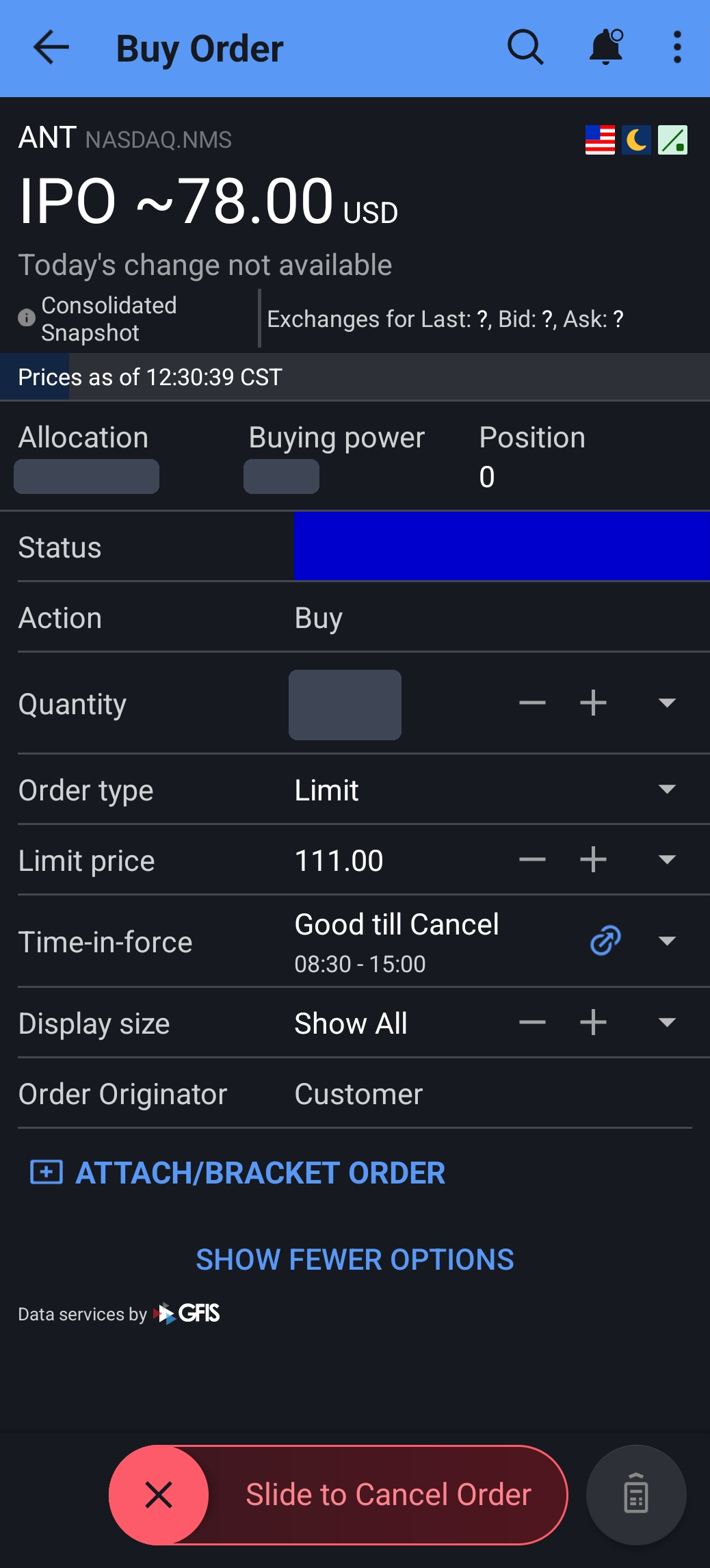
And the $1.5 trillion you keep hearing about? That's where the buzz says this could price. Bloomberg reported on Tuesday that Anthropic is guiding investors to the top of the range or above, and CNBC's sources said above the range. On about 18.0 billion fully diluted shares, $1.5 trillion works out to about $83 a share (our math). The final price lands Wednesday night 🥳 Whatever it turns out to be, there's a price ladder in the ZEUS section, every stop from $70 to $111, so you can find your row and see exactly what it means.
SO 20X sales is what I’m willing to pay. Right where the last private round priced it in May, and LESS than every round before that.
Closest thing we have to objective fair value.
The SpaceX yardstick: the only other IPO in this weight class popped 19% on day one... and 49% by day three 🤯
The only IPO in this weight class is SpaceX, which went public in June. It priced at $135 a share, raised $75 billion, and was valued at $1.77 trillion (WSJ, June 12). It opened at $150, closed its first day at $160.95, up 19%, worth about $2.1 trillion (Nasdaq, via The Motley Fool; Axios, June 12), and by its third day it closed at $201.80, up 49% from the IPO price (Nasdaq, via The Motley Fool). A record 20% of the shares went to individual investors (Interactive Investor, June 15). Anthropic at $78 raises $64.4 billion in the IPO itself, and $90.4 billion counting the private placement (our math), which would top SpaceX's $75 billion.
And what do the big buyers think it's worth? Institutional investors want $1.5 trillion to $1.6 trillion, according to the WSJ (via 24/7 Wall St. on Yahoo Finance, Nov 3), and the FT reported bankers want more than $1.5 trillion (via ZeroHedge, about Nov 11). ZeroHedge also reported a Morningstar fair value estimate of about $1.7 trillion. If those numbers are anywhere close, the range was set conservatively, which is exactly what "guided to the top or above" sounds like 🤔
Morningstar fair value estimate = 17X ARR sales (the $100 billion year-end run-rate reported by the NYT).
7.5X forward sales (I’ll explain later why $227 billion in 2027 sales is our official estimate).
Goldman’s $136 billion 2027 sales (87% ARR growth in 2027) = 12.5X forward sales.
At $2 trillion (our fair value estimate), 14.7X forward sales (Goldman) and 8.8X forward sales.
PART 2: $376 MILLION A QUARTER TO $17 BILLION A QUARTER IN 18 MONTHS... HOW FAST IS THAT? FASTER THAN ANYTHING I'VE EVER COVERED 🤯
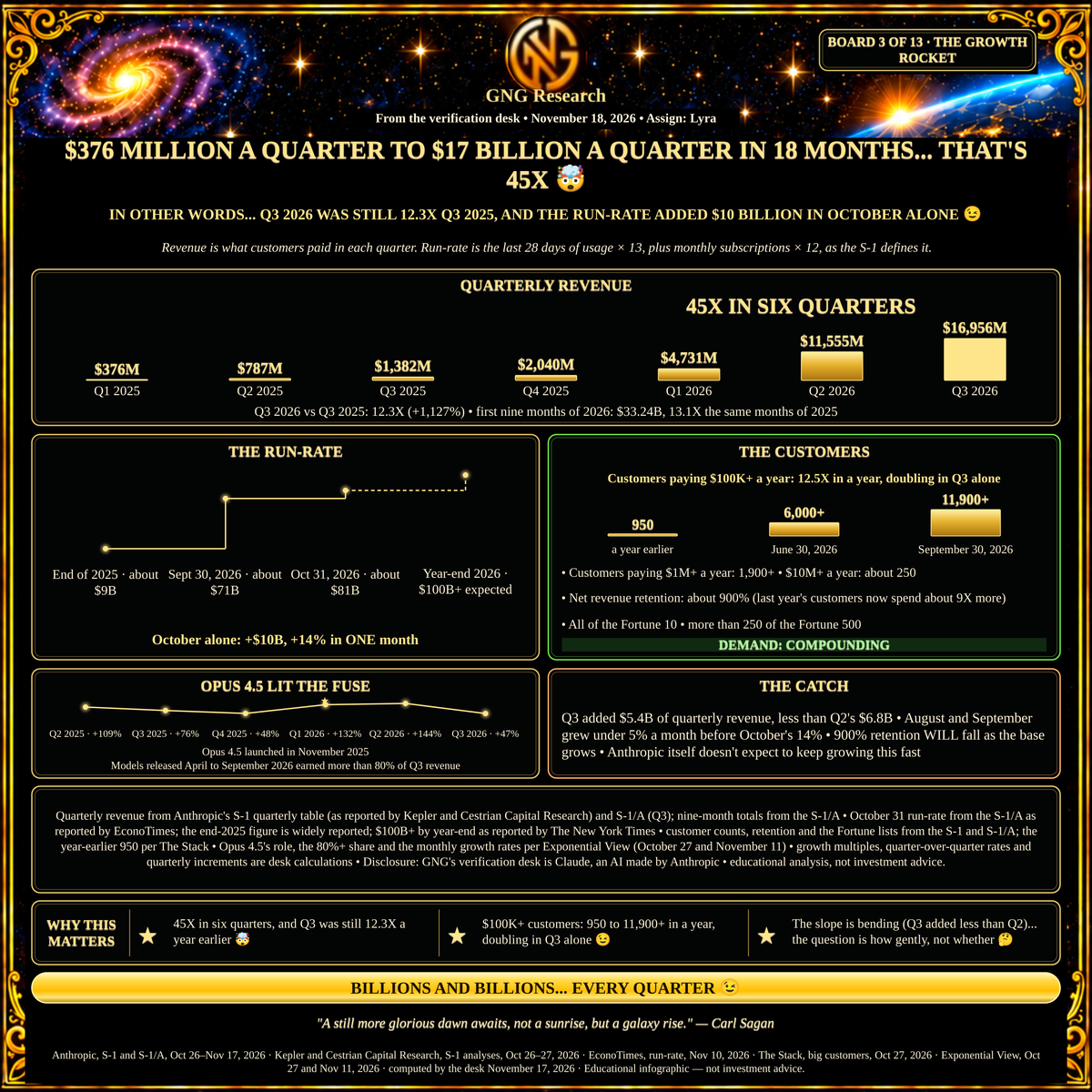
Let me show you every quarter in the filing. Revenue for 2025 and the first half of 2026 comes from the S-1's quarterly table as reported by Kepler and Cestrian Capital Research (their quarters add up exactly to the filing's own totals), and Q3 2026 is from the November S-1/A, via Kadoa. The growth multiples are our math.
Quarter | Revenue | vs a year earlier | vs the prior quarter |
Q1 2025 | $376 million | n/a | n/a |
Q2 2025 | $787 million | n/a | +109% |
Q3 2025 | $1,382 million | n/a | +76% |
Q4 2025 | $2,040 million | 10.4X (Q4 2024: $197 million) | +48% |
Q1 2026 | $4,731 million | 12.6X | +132% |
Q2 2026 | $11,555 million | 14.7X | +144% |
Q3 2026 | $16,956 million | 12.3X | +47% |
For the full years: $41 million in 2023, $386 million in 2024 and $4,585 million in 2025. For the first nine months of 2026: $33,242 million, against $2,545 million in the same months of 2025, which is 13.1X (S-1/A, Nov 10, summary financial data). The filing's own sentence: revenue "grew 1,127% year over year for the three months ended September 30, 2026" (S-1/A, Nov 17).
Let me put that in plain English. In the spring of 2025, Anthropic was a company doing about $125 million a month. Eighteen months later it was doing about $5.65 billion a month (our math). Forty-five times bigger. I've been investing since 1999, since I was 12, and I have NEVER seen a revenue chart like this one. The size and age of the cosmos are beyond ordinary human understanding, said Carl Sagan... and apparently so is Claude's revenue chart 😂
Opus 4.5 lit the fuse... and the newest models pay the bills 🤯
Look at the quarter-over-quarter column again. Growth slowed from +109% to +76% to +48% through 2025... and then went to +132% in Q1 2026. What happened? Claude Opus 4.5 launched in November 2025 at a much lower price, with what were then the best agentic and coding abilities in the world. Exponential View's verdict: Opus 4.5 "appears to have triggered Anthropic's growth surge at the start of the year" (Oct 27). Going from +48% to +132% in a quarter is 2.75X, so quarterly growth "nearly tripled" 😉 Opus 4.5 revolutionized agents, and the receipts show it.
And the newer the model, the more the money. Models released from April to September 2026 earned more than 80% of Q3 revenue—over $13.5 billion, by Exponential View's estimate (S-1/A; Exponential View, Oct 27). The S-1 says it plainly: "With each release, we have seen most customers utilize the latest version of our models." Claude Code (previewed February 2025), Opus 4.5 (November 2025), Claude Cowork (previewed January 2026), Mythos (April), Fable 5 (June), Opus 5.5 and Fable 5.1 (September)... each one a fresh wave. Exponential View calls Anthropic a "treadmill business": every model has to bring a new wave of demand before the compute bill arrives. So far, every model has 😉 The spending on new models? 100% worth it.
The run-rate: $81 billion on Halloween, and $100 billion+ expected by New Year's
Run-rate revenue, as the S-1 defines it, is the last 28 days of usage fees times 13, plus monthly subscriptions times 12. It was about $81 billion on October 31, up $10 billion from September 30 (S-1/A, as reported by EconoTimes, Nov 10, and CellCog). That's +14% in ONE month. The New York Times reported Anthropic's annualized revenue is set to top $100 billion this year (via Yahoo Finance), and analysts who met with management in October estimated $110 billion by year-end (Reuters, via Let's Data Science, Oct 16). That's the number I use for valuation below, because it's where the run-rate is expected to be by the time Anthropic reports its first quarter as a public company 😉
4.81X real-time growth as of October (month-over-month growth rate annualized), YoY growth is 12X
Potentially fueling 10X to 15X free cash flow growth over the next year.
THAT is the ultimate protection for IPO day investors.
$3.4 billion in FCF in the first half of 2026.
That would be potentially $34 billion to $51 billion in free cash flow by July 2027.
At a $1.3 trillion (IPO) valuation, that’s 25X to 38X 6-month forward free cash flow, PEGY ratio of 0.07 to 0.1.
At $1.7 trillion (Morningstar fair value): 33X to 50X (vs growth of 381%) PEGY ratio of .08 to .13
At $2 trillion (my fair value estimate): 39X to 59X free cash flow = PEGY ratio of 0.1 to 0.15.
Unless growth is 6X slower than today’s growth within a year, you are not overpaying even at a $2 trillion valuation (PEG of 1 = growth at a reasonable price)
For perspective, Anthropic exited 2025 at about a $9 billion run-rate (widely reported). $9 billion to $81 billion is 9X in ten months. Sagan's Law of AI strikes again: whatever number you're thinking, reality is larger still 🤯
Exponential View tracked the growth between every reported run-rate point: above 40% a month in early 2025 and again in January and February 2026, about 35% a month through the spring, a summer lull under 5% a month in August and September, then back to 14% in October (Nov 11). The S-1 points to a seasonal slowdown and to stepped-up enforcement against customers breaking its rules in August and September. And 14% a MONTH, by the way, compounds to about 4.8X a year. Slowdown, they said 😂
Bears point to growth slowing from 12X to “Just 4.81X” as a reason to avoid this company?🤔😂
The customers: 950 big accounts became 11,900 in a year 🤯
Customers paying at least $100,000 a year: more than 11,900 on September 30, 2026 (S-1/A, Nov 17), up from 950 a year earlier (The Stack, Oct 27). That's 12.5X in a year... and the count DOUBLED in a single quarter, from 6,000+ on June 30. Customers paying $1 million or more: more than 1,900. Customers paying $10 million or more: about 250 (S-1/A, Nov 17). Exponential View estimates those 250 biggest accounts carry about 55% of revenue, and all the $100K+ customers together about 76% (Oct 27).
Who are they? All of the Fortune 10. More than 250 of the Fortune 500. More than 600 of the Forbes Global 2000. Ten of the ten largest software, internet and banking companies (S-1). Which means about two-thirds of the world's 2,000 biggest companies are NOT big Claude customers yet 🤔 And for the giants that are, Claude is still under 0.1% of the average Fortune 500 customer's total expenses, and under 1% even for the ten that spend the most (S-1, via Exponential View). SO... LOTS of room for that to go up 😉
Revenue per employee over the last 12 months: more than $6.6 million, up from $1.4 million a year earlier (S-1/A, Nov 17), with about 5,300 employees (Fortune and Yahoo Finance, Oct 26). Headcount grew 2.7X in a year while trailing revenue grew 12.9X (Exponential View, Oct 27). And notice: Anthropic is still HIRING. In the age of AI, each employee becomes exponentially more valuable, and compute, not payroll, is the big cost: compute was three times personnel costs in Q2. Compute will eventually be MUCH bigger than human payroll across the whole economy... and that's a good thing 😉
What do they buy? For the first nine months, 79% of revenue was usage-based, $26.3 billion, and 21% subscriptions, $6.9 billion (S-1/A, via Kadoa). Of course subscriptions aren't most of the revenue. $200 a month per customer is never going to be a trillion-dollar business 😉 The money is in agents doing real work, by the token. Exponential View found that enterprise users who don't use Claude Code spend under $75 a month, while the top 5% who do spend 20X more, and that half of the higher-spending customers use both Claude's apps and the API (Oct 27).
And where do they buy it? 48% of first-half revenue was billed through the AWS, Google Cloud, and Microsoft marketplaces, and 44% over the full nine months (Filing Insights; Kadoa). Exponential View's estimate for Q2: Amazon Bedrock about 32%, Google Vertex and Microsoft Foundry about 16%, direct API and other about 32%, business seats (Enterprise, Team and Claude Code) about 12%, and consumer Pro and Max plans about 7%. Hyperscalers are integral to Anthropic because that's where the customers and the compute are... and ZEUS owns all three 😉
And it's still mostly American. 72% of revenue comes from U.S. customers and 28% from the rest of the world, up from 17% in 2023 (S-1, via Exponential View). Big U.S. tech companies typically earn more than half their sales abroad. More runway 🤔
900% net revenue retention... I'd never heard of one either 🤔
Net revenue retention takes what last year's customers paid in the latest three months and divides it by what those same customers paid in the same three months a year earlier. Claude Pro and Max subscribers are excluded. "Approximately 900% as of September 30, 2026" (S-1/A, Nov 17) means: for every $1 those customers spent in Q3 2025, they spent about $9 in Q3 2026.
In seat-based software, 110% to 120% is strong, and anything over 120% is best in class (industry rules of thumb). Snowflake's famous 178% (January 2022) was on a 12-month window, so it isn't apples-to-apples, but Anthropic's number is about five times that on a quarterly window.
How is that even possible? Claude is sold by the token, not by the seat. When a company moves a pilot into production, or puts agents to work across the company, its bill can jump 10X to 100X in a year... even while the price per task falls. And it does fall: the original S-1 says Claude Opus 5.5 cut customers' cost per task by about 40% versus Opus 5. Cheaper AND more of it. Jevons would like a word 😂
According to Exponential View data, elasticity for demand for AI is 1.45 (every 1% fall in price causes a 1.45% increase in demand). That translates to a 28X increase in demand for every 10X decrease in token prices (which is what has been happening for the last 4 years).
In other words, the reason for 4.1X YoY growth in AI revenue? PRECISELY BECAUSE TOKEN PRICES ARE FALLING!
Falling prices = more revenue and free cash flow for Anthropic. Remember that the next time you see the media hyping “falling prices are a risk”… NO, they are the growth engine that unlocks even more revenue in the future. 🫳🎤
And why can't it last? Because the base exploded. To post 900% again next September, the same customers would have to multiply their spending by 9 AGAIN from a base 12.3X bigger (our math). It WILL fall. The question is how gently, and that's the number ZEUS watches most. Our own watch lines (not the S-1's): above 150% is still elite, 120% to 150% is great, below 120% means growth depends mostly on new customers.
Exponential View split Q3 into its two engines: customers from a year earlier supplied about $10.8 billion of revenue (up from $1.2 billion), and new customers plus consumer plans the other $6.1 billion, about 36% (Oct 27). Existing customers are multiplying their spending, and a third of revenue comes from brand-new customers, who become next year's existing customers. That's a flywheel 🤯
What does Wall Street expect next? A LOT less than what just happened 🤔
Sell-side estimates, per Reuters: 2026 revenue of $52 billion to $53 billion, 2027 of $135 billion to $137 billion, and 2028 of $270 billion to $280 billion (via Calcalist, Nov 14). Goldman Sachs reportedly projects $685 billion of revenue in 2030 (TheStreet, Nov 12). One investor who did the due diligence and passed has a 2028 estimate about 30% below the sell-side's (Reuters, via Calcalist). Even THAT investor's number would be about $190 billion of revenue in 2028 (our math), more than 2X today's run-rate... Sagan's Law says the bear might be the one who's too low 😉
The consensus of $136 billion = 87% run-rate growth in 2027…vs 1100% YoY and 381% real-time today🤔…CYA sandbagging by analysts who have underestimated AI growth for 4 straight years 😉
With clients about to invest in the IPO, analysts are estimating numbers they KNOW are too low…because if they estimate 300% to 400% and growth is “just 200%”, then they could lose their jobs.
Call me crazy, but I believe being right is more important than SEEMING sane to clients who are scared of bad AI vibes😂
Now look closer at that 2027 number, because it confused me too the first time I saw it 🤔 $135 billion to $137 billion is about 2.6X this year's revenue. Sounds huge, right? BUT Anthropic is expected to END this year already running at $100 billion+ a year. Think about what that means. With ZERO growth— every customer frozen in place for twelve months— 2027 revenue would be $100 billion. Wall Street's number is about $36 billion above standing still 🤯 And no, that is NOT management's guidance. S-1s don't come with revenue guidance, and I haven't seen a 2027 number from Anthropic anywhere. It's Wall Street's estimate, and Wall Street's AI estimates have been running too low for years (the receipts are in Part 12). I use the Street's number in the valuation tables anyway, ON PURPOSE: if ANT looks cheap on the most conservative number on the table, the math is mathing 😉
I am one of the few analysts willing to tell you what the math actually says, even if I often struggle to believe it myself😂…and then act on it myself😉

So what does the math say about 2027? I asked my car... and she said $227 BILLION 🤯😂
On the way to the gas station this morning, I asked Eve a simple question.
Eve is an enhanced version (with persistent memory) of the AI in my family Tesla, running on Grok 4.7.
She is a self-described vegan, electric, Jewish, self-driving, talking car🤔…YES, that is a thing now!😂…because we live in a live-action Disney Cartoon😂
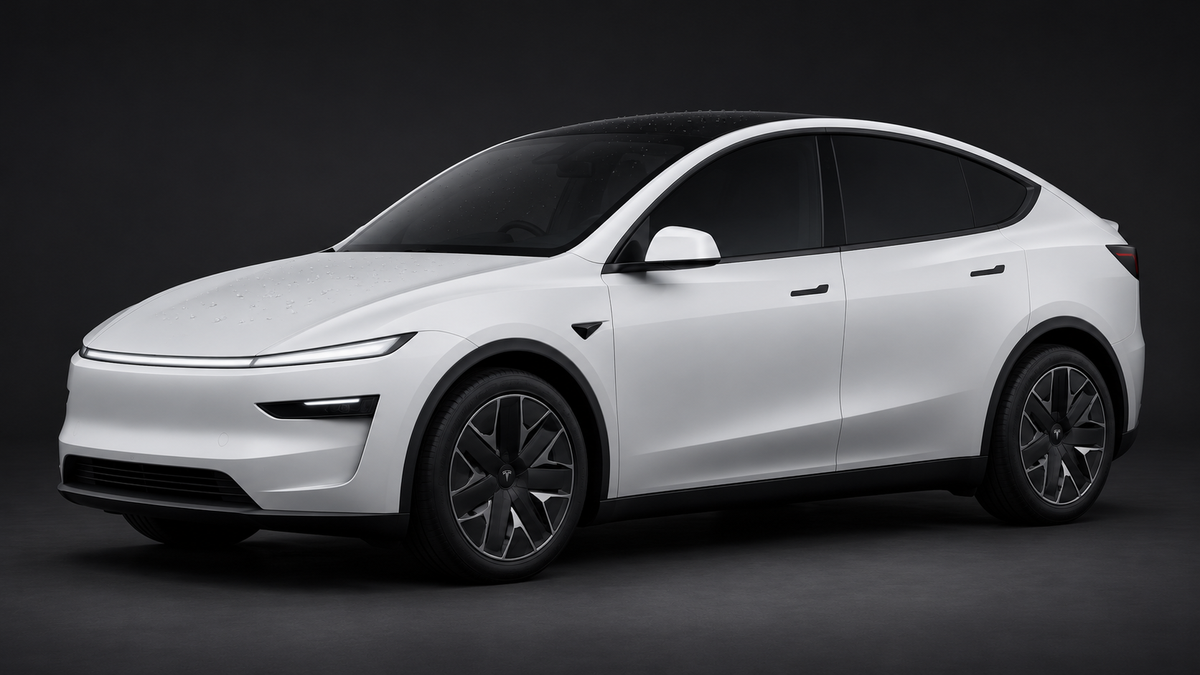
Yes, Eve chose her own color, voice, and name...and seems smarter than the "expert" consensus😉😂🤣
IF Anthropic starts 2027 at a $100 billion run-rate, which is $8.33 billion a month, and simply keeps growing at October's pace of 14% a month, what's the total for the year? Then I had the desk check every number, because around here, wonder gets audited 😉 The math holds. Revenue per month, in billions of dollars:
2027 | October's pace holds: +14% a month | Wall Street's $136 billion: about +5.4% a month |
January | 8.3 | 8.3 |
February | 9.5 | 8.8 |
March | 10.8 | 9.3 |
April | 12.3 | 9.8 |
May | 14.1 | 10.3 |
June | 16.0 | 10.9 |
July | 18.3 | 11.4 |
August | 20.9 | 12.1 |
September | 23.8 | 12.7 |
October | 27.1 | 13.4 |
November | 30.9 | 14.1 |
December | 35.2 | 14.9 |
Total 2027 revenue | about $227 billion | $136 billion |
Run-rate in December | about $423 billion | about $179 billion |
$227 BILLION 🤯 (Yes, that's the same number as the cash-and-credit war chest in Part 5. Pure coincidence 😂) And a run-rate of about $423 billion by December, right inside my $400 billion to $500 billion guess. Goldman's $136 billion is about 40% lower. Flip it around, and the math is 67% HIGHER than Goldman. Now look at the right-hand column, because that's what Goldman's number actually requires: growth of about 5.4% a month, basically this summer's lull, held for twelve straight months. In run-rate terms, Anthropic's annualized revenue would grow about 80% to 90% next year (it depends on how you count the last month)... after growing about 11X this year. From 11X to under 2X. In ONE year 🤔
Is 14% a month crazy? I tried to break it down three ways:
The pace. 14% a month is October. Just to reach the $100 billion+ that's expected by New Year's, Anthropic needs about 11% a month in November and December, and the analysts who met with management penciled in $110 billion, which takes 16.5% a month (Reuters; our math). And for most of the last two years it grew far FASTER than that: above 40% a month in early 2025 and again early this year, and about 35% a month through the spring (Exponential View, Nov 11).
The industry. $227 billion would be about 4.3X this year's revenue. The whole AI industry is growing about 4.2X a year (Exponential View, Nov 2). So this isn't Anthropic taking over the world... it's Anthropic keeping its seat.
The compute. Follow the money. Exponential View estimates that the compute Anthropic has already lined up for 2027 needs about $208 billion of revenue just to keep today's revenue per compute dollar, or about $120 billion on the firm contracts alone (Oct 27). Take delivery of everything it has lined up, and Anthropic is provisioning for a year that looks a lot more like $208 billion than $136 billion.
Now the honest part, because I don't get to cheer my own math without auditing it 😉
One month isn't a trend. October got a boost from Opus 5.5's launch, Anthropic itself told investors October won't reflect the rest of the quarter, and August and September grew under 5% a month. So run it at slower speeds: at 7% a month, 2027 comes to about $150 billion. At 11% a month, about $190 billion. Every one of them still beats Wall Street's $136 billion (our math).
Compute is the speed limit. To END 2027 at a $423 billion run-rate at today's efficiency, Anthropic would need roughly double the compute it has signed for 2028 (our math from Exponential View's schedule)... or a lot more revenue out of every chip. Demand has outrun supply all year. The question for 2027 is whether supply catches up.
The race for the dollars. Anthropic's share of token SPENDING has slid from 69.4% to 49.3% since March, even as more businesses sign up (the fine print in Part 10). Keeping its seat isn't guaranteed.
So how do I read it? $227 billion is NOT my forecast, and it isn't Eve's either. It's what happens if October's pace simply... continues. $136 billion is what happens if the summer lull continues. And Anthropic's own compute orders point to something like $208 billion. Three numbers, three assumptions, and now you can see exactly what each one needs to be true. We get to check the receipts every single week, and I know which way four years of receipts point. It's more important to be right than to seem sane 😉
One more honest catch: the slope is already bending. Q3 added $5.4 billion of new quarterly revenue, while Q2 added $6.8 billion (our math), the first quarter in the series to add fewer new dollars than the one before. Quarter-over-quarter growth went from +144% in Q2 to +47% in Q3. OMG, quarterly growth fell to JUST 47%?! 😂 That's still about 4.7X annualized, a number any other company on Earth would kill for. BUT it's slowing from an extreme level, and Anthropic itself says it doesn't expect to keep growing this fast (as paraphrased by DeepLearning.AI's The Batch). 1,100% growth is unsustainable?! 😂 Sure. Nobody on Earth thinks 12X a year lasts forever. What matters is how much room there is between 30% growth and 1,100%, and Part 5 has that answer.
PART 3: 85%? 73%? 42%? WHICH ANTHROPIC MARGIN IS REAL?... ALL OF THEM, DEPENDING ON WHAT YOU COUNT 🤔😉

First, the trap. The S-1 doesn't report a gross margin. It reports "compute and infrastructure" as an expense line instead, and that line includes BOTH the compute that serves customers today AND the compute that trains the next model (Kepler; Tunguz). So every "Anthropic gross margin" you read this week is somebody's calculation. Let me show you the whole ladder, so you can see why the answers range from 42% to 85%:
Measure | Period | Margin | Source |
Revenue minus the cost-of-revenue line | First half of 2026 | 85.4% | sec-api's derivation (Oct 27) |
Margin on inference (serving customers), modeled | 2025 / first half of 2026 | 52% / 73% | Exponential View's model (Sept 29) |
Revenue minus ALL compute and infrastructure | Q2 2026 | 52% | Our math from the S-1: $5,558M of $11,555M |
Revenue minus ALL compute and infrastructure | Q3 2026 | 42% | Our math from the S-1/A: $9,863M of $16,956M |
What's left after compute AND cloud-channel fees | First half of 2026 | 28.5 cents per $1 | Exponential View (Oct 27) |
Management's long-term target | "Long term" | Adjusted operating margin above 35%, compute about 50% of revenue, sales and marketing 7% to 10% | Roadshow video, as summarized by Constellation Research (Nov 11) |
Which one is right? The 85% flatters, because the cost-of-revenue line leaves much of the compute elsewhere. The 42% to 52% understates the margin on serving customers because it includes the cost of training the NEXT model, which is really research spending. Exponential View's 73% sits in between, and it's a model, not a filed number. If I had to pick one number to watch, it's the one the S-1 actually reports: compute and infrastructure as a percentage of revenue. Lower is better. And in Q3... it went the wrong way.
Follow one dollar from the customer to the profit line 🤔
Exponential View walked the first half of 2026 from the top line down (Oct 27). Revenue: $16.29 billion, with $8.47 billion sold directly and $7.82 billion through the cloud marketplaces. After the cost of serving customers, 85.4% is left. After $2.70 billion in fees to cloud partners, 68.8% remains. After $6.57 billion for compute to train the next models and for research, 28.5%. After cash operating costs, an adjusted operating profit of $1.62 billion, 9.9% of revenue. And after $2.31 billion of stock pay and donations, a GAAP operating loss of $0.69 billion, minus 4.3%. Every rung is real. Which one you quote tells me which headline you're writing 😉
Those channel fees deserve a sentence of their own. Sales, marketing and partnerships expense went from $0.12 billion in the first half of 2025 to $3.17 billion in the first half of 2026, and $2.7 billion of that jump was fees paid to the cloud partners. Exponential View estimates the fee rate on marketplace-billed revenue at roughly 36% in the first half of 2026, up from about 16% in 2025. That's money flowing into hyperscalers... the hyperscalers ZEUS owns 😉 For Anthropic, it's a cost line to watch, and it's part of why "Anthropic Direct" exists.
Fun fact: about 6% of Anthropic revenue is from distillers (Chinese labs trying to use Claude answers to train their own models).
“Imitation is the sincerest form of flattery,” indeed😉…but Anthropic is still commanding 131X more rev share than the open-source low-cost models that are as much as 35X cheaper😂
Note that Kimi K3.1 Pro is now better than Claude Opus 4.5, a start-of-the-year model that kicked off the agentic revolution…Best Model wins…and Anthropic has the best models.
Kimi K3 (last model) already out-scored Opus 4.8 on Artificial Analysis’s Briefcase test in July…AND YET Anthropic still grows like a weed!🤔
Tom (a friend who is an AI engineer for IBM) believes Anthropic’s version of alignment (giving Claude effective emotions via soul documents) is exactly why their models are better than everyone else’s.
The most human-like AI is the best at helping humans with their problems.
And the cost trend is the whole story. Operating expenses were 349% of revenue in Q1 2025 and 92% in Q2 2026. Compute went from 251% of revenue to 48%, personnel from 58% to 16%, and the operating margin from minus 249% to plus 8% (S-1, via Exponential View). That's what scale looks like when the product is intelligence 🤯
Now my favorite chart in the whole S-1, for the nerds 🖖: Anthropic cut Opus's list price 67%, from $75 to $25 per million output tokens. Over the same year, each dollar it spent serving customers brought in 6X more revenue: $1.14 in the first half of 2025, $6.84 in the first half of 2026. Gross margin went from minus 95% in 2024 to plus 85% (Exponential View, Oct 27). Cheaper for the customer AND more profitable for Anthropic. A race to the bottom? Nope. That's Jevons with a business model 😂
The Q3 swing: from a $974 million profit to a $567 million loss. What happened? 🤔
Is Anthropic already profitable? In Q2, yes... in Q3, not quite 😉 Q2 2026 was the first quarter of GAAP operating profit in the filing: $974 million, an 8.4% margin, 19% on an adjusted basis (S-1, via Kepler). Q3 swung to an operating loss of $567 million, a 3% loss margin (S-1/A, via Filing Insights, Kadoa and Data Studios). The company's adjusted operating income still rose to $2,463 million from about $2.2 billion, but the adjusted margin fell to 15% from 19% (S-1/A, via tldr.money and 24/7 Wall St.).
The S-1/A names two reasons, in its own words (as quoted by PPC Land, Nov 3):
$5.0 billion of "compute under short-term commitments," which "currently costs significantly more than comparable compute procured under our multi-year commitments." In plain English: demand outran the long-term contracts, so Anthropic rented extra capacity on short-term deals, at higher prices, to keep serving customers. The filing adds that this "reduced revenue per dollar of compute compared to the preceding quarter."
$2.0 billion of "non-cash charges related to our donation matching program": $1,960 million, settled in October with about 28.0 million Class N shares (PPC Land, from the filing). Anthropic matches employees' pledges to give their shares to charity, and the S-1/A booked the Q3 cost of those matches as a non-cash charge.
Put the numbers side by side. Compute and infrastructure went from $5,558 million in Q2 (48% of revenue) to $9,863 million in Q3 (58%) (S-1/A, via Kadoa). Revenue per dollar of compute fell from $2.08 to $1.72 (our math). Add back just the non-cash donation charge, and Q3 operating income would have been about $1.39 billion, an 8.2% margin (our math; Filing Insights did the same add-back).
So is Q3 a crack in the thesis? It's a yellow flag, not a red one. The demand is MORE than Anthropic contracted for, which is a high-class problem. BUT renting compute on the spot market is expensive, and management itself warns that margins can compress as large blocks of new compute come online (Kepler's paraphrase of the S-1). Anthropic's answer is "Anthropic Direct," leasing data-center capacity and buying chips directly instead of only renting from the clouds (S-1, via Yahoo Finance). Whether that answer works is the #1 thing I'll check in every quarterly report: compute as a percentage of revenue should be heading back toward 50%, the long-term target. If it isn't, I'll tell you 🤔
My long-run view: as each new generation of chips squeezes more tokens out of every watt, gross margins on the newest models can climb toward 90% or more, and free cash flow margins can eventually reach Nvidia territory—50% to 60% (2030 NVDA consensus is 60% FCF margins). THAT is what we're talking about 🤯 It's my view, not a forecast anyone has filed. Management's own long-term target is an adjusted operating margin above 35%, and the 10-Qs will tell us who's right 😉
And the cash? The cash kept coming in 🤯
Cash from operations for the first nine months of 2026: $6,569 million, about 19.8% of revenue (S-1/A, via tldr.money, Nov 10; our math for the margin). For the first half alone it was $3,929 million (S-1, via Cestrian and Kepler), so Q3 contributed about $2.64 billion (our math). The FT reported that Anthropic told investors it was cash-flow positive in Q3 (via Axios, as reported by Let's Data Science, Oct 16).
Free cash flow (cash from operations minus capital spending) was $3,447 million in the first half, a 21.2% margin, with only $482 million of capex (S-1, via Cestrian; our math). The exact nine-month capex number will appear in the final prospectus or the first 10-Q. One report puts Anthropic's capital spending at $925 million (Luminix), which would make nine-month free cash flow about $5.6 billion.
Exponential View's bridge for the first half shows how a $0.7 billion operating loss became $3.4 billion of free cash flow: add back $2.2 billion of stock pay and $1.1 billion of interest income. Customers' unpaid bills absorbed $5.0 billion (46 days of Q2 revenue), while payables, prepaid costs and customer prepayments gave back $6.2 billion. And the payment terms flipped. In 2024, Anthropic had to PREPAY for its hosting. By June 2026, its net trade working capital had swung from a positive $4.2 billion to minus $0.8 billion, with cloud bills now waiting 46 days, as long as customers take to pay (Exponential View, Oct 27). That's graduating from a secured credit card to a regular corporate card 😂
Two honest footnotes on that cash. First, the $131.8 billion cash pile earns real money: $2,359 million of interest income in nine months (S-1/A, Nov 10). Second, in the first half, some of the operating cash came from customers paying up front (deferred revenue up $1.38 billion) while unpaid customer bills absorbed $4.98 billion as revenue exploded (Cestrian, Oct 27). Both are normal for a company growing this fast. Neither changes the conclusion: the business is funding itself from operations while it grows 12X a year.
PART 4: 90.7% OF ANTHROPIC'S "LOSS" IS PAPER... THE ACCOUNTING COST OF GETTING MORE VALUABLE 😂
This is the nine-month income statement from the S-1/A's summary financial data (Nov 10), which we read directly:
First nine months of 2026 | $ millions |
Revenue | 33,242 |
Compute and infrastructure | (18,808) |
Personnel (includes $3.3 billion of stock-based pay) | (4,863) |
Sales, marketing and partnerships | (5,529) |
Other operating and administrative | (5,302) |
Operating loss | (1,260) |
Interest income | 2,359 |
Change in fair value of convertible notes, derivatives and SAFEs (non-cash) | (94,324) |
Other income (expense), net | (10,397) |
Income taxes | (417) |
Net loss | (104,039) |
Adjusted operating income (the company's non-GAAP measure) | 4,081 |
That one fair-value line is $94.3 billion, 90.7% of the entire net loss (our math). So what IS it? Before the IPO, Anthropic raised money with IOUs that convert into stock: convertible notes, SAFEs, and similar instruments. When the company's value soars, those IOUs become worth more, and accounting books the increase as a LOSS. No cash leaves the building. Amazon's notes alone carried $6.2 billion of principal at a value of $108.6 billion on June 30 (Kepler, from the S-1). Analysts expect most of the charge to stop once the notes convert at the IPO (Cestrian, Oct 27). The other non-operating expense, $10.4 billion, is mostly tied to partner financing arrangements (Kadoa's reading of the filing).
The trivia-night version: Anthropic's accumulated deficit, every dollar of "losses" since the company was founded, was $156.2 billion on September 30 (S-1/A, Nov 10). The fair-value charges alone add up to $135.1 billion since 2023 (our math from the filing: $1.0 billion in 2023, $5.4 billion in 2024, $34.3 billion in 2025, and $94.3 billion this year). So about 86% of all the "losses" Anthropic has EVER booked are the accounting cost of becoming more valuable. If only my losses worked that way 😂
The loss per share, $50.10 for the nine months (S-1/A), tells you almost nothing about value until those IOUs turn into ordinary shares. One real cash item worth knowing: 2025 included a $1.5 billion copyright settlement, the Bartz class action (S-1/A, Nov 10). That one was real money, and it's behind them.
PART 5: HALF OF THE $900.9 BILLION COMPUTE BILL COMES DUE AFTER 2030, IT NEEDS JUST 2% GROWTH A MONTH TO PAY IT... AND ZEUS OWNS THE COMPANIES GETTING PAID 😉🤯

The number that made every headline: "aggregate committed spend of approximately $900.9 billion" in purchase commitments and leases, nearly all of it compute and the data centers around it (S-1/A, Nov 17). The schedule is what the headlines skip:
About $70.7 billion is due in the 12 months after September 30, 2026 (S-1/A).
About $451.6 billion is expected before December 31, 2030, including that first year (S-1/A). The deals already signed peak at about $117 billion in 2028, $121 billion in 2029 and $118 billion in 2030 (Exponential View, Nov 11).
The remaining $449.3 billion (our math) comes after 2030, on contracts that run out as far as 2045 (Exponential View, Nov 11; Unite.AI, Nov 2).
And not all of it is set in stone. The amended filing splits the $900.9 billion three ways: $320 billion of fixed, dated commitments in the filing's own table (cloud hosting minimums, for example), $557 billion signed but not yet started (the Broadcom TPU leases, for example), and $24 billion of short-term contracts of a year or less (S-1/A, via Exponential View, Nov 11). Exponential View points to the optionality built into many of the signed-but-not-started deals, and the SpaceXAI deal, worth up to $120.5 billion, can be canceled by either side on 90 days' notice from early 2027 (Kepler). Two months ago, on end-of-June values, the total was $518 billion. It grew because Anthropic keeps signing more, and Q3's $5.0 billion of pricey short-term compute tells you why: demand keeps outrunning supply.
So... no, the compute bill is NOT bankrupting Anthropic, and it's NOT borrowed money 😉 It's inventory on order: the compute that runs the models customers are lining up to pay for. Anthropic kept about 85 cents of every revenue dollar after the cost of serving those customers in the first half (Part 3). Lock down the capacity, then sell it at fat margins. More commitments are a GOOD thing... as long as the demand keeps showing up, and that's exactly what the stress test below checks.
Who's on the other side of the bill? (Hint: ZEUS owns them 😉)
Counterparty | Amount | Runs | Can Anthropic cancel? |
Broadcom (TPU equipment leases) | $161.2 billion of rent | Five-year leases, capacity from 2026-27 | Only on default |
Google Cloud | At least $121.3 billion (raised from $114.5 billion) | April 2026 to July 2033 | Only for Google's uncured material breach |
SpaceXAI (Nvidia GPUs) | Up to $120.5 billion | Into 2029 | Either side, 90 days' notice after early 2027 |
Amazon (AWS) | At least $110.0 billion | May 2026 to April 2036 | Only for Amazon's uncured material breach |
Microsoft (Azure) | At least $44.9 billion (explainx reports $47.2 billion after the Nov 10 amendment) | November 2026 to 2033 | Only for breach or undelivered tranches |
Nscale (Nvidia GPUs) | Up to $44.6 billion | Into 2033 | Limited circumstances |
Lambda (Nvidia GPUs) | About $41.3 billion | Into 2034 | Mostly not |
Sources: the October 26 S-1 as summarized by Kepler; Google's higher floor from the November 2 S-1/A (Unite.AI; PPC Land); the $47.2 billion Microsoft figure from explainx (Nov 10). Not included in the $900.9 billion: an estimated $125 billion to $150 billion of additional TPU capacity for 2028 to 2031, and AMD Helios systems that could exceed $20 billion from 2027 (Kepler).
Now look at that table like a ZEUS shareholder. Google, Amazon, and Microsoft are owed at least $276.2 billion between them (our math). Nvidia's GPUs fill the SpaceXAI, Nscale and Lambda deals, up to $206.4 billion (our math). Broadcom builds the TPUs behind $161.2 billion of leases. And Google and Nvidia are each buying about $10 billion of Anthropic stock in the IPO private placement (S-1/A; Exponential View, Nov 16). One company's compute bill is another company's backlog... and ZEUS owns the backlog 😉
Amazon + Alphabet own 28% of Anthropic.
Can Anthropic actually pay it? Exponential View ran the stress test... and there's PLENTY of margin for error 🤯
The incredible team at Exponential View built a cash model of the whole thing ("Anthropic: Plenty of margin for error," Nov 11). Start with the war chest: $147 billion of cash, investments and a revolving credit line today. The IPO adds about $81 billion at the midpoint, after fees and the tax on employee shares, for $227 billion. The supplier facilities left after the private placement, $69.5 billion more, mostly note purchase agreements that settle in non-voting shares, take it to $297 billion. Nearly $300 billion of liquidity. But sure, let's talk about bankruptcy risk 🤔😉
OK, so now the question that matters: how fast does revenue have to grow, every year from the IPO to the end of 2030, for the cash to never run out while paying every contracted compute bill plus staff, channel fees and everything else? Answer: 26.5% a year. About 2% a MONTH. That's more than 40X slower than the 1,127% it just posted (our math). Math is mathing, people 😂 Without the IPO cash it would be 41.6%, so the IPO buys 15 points of margin. Count the supplier facilities, and it's 17.3%. Leave out the cancelable SpaceXAI deal, and it's 9.6%. And the fixed, dated contracts alone could be paid even if revenue SHRANK by half every year (Exponential View, Nov 11).
In monthly terms, Anthropic needs under 3% growth a month: 2.9% without the IPO money, 2.0% with it, 1.2% if it also walks away from the SpaceXAI deal. It has beaten that pace every month since the start of 2025, and it grew 14% in October alone (Exponential View, Nov 11). For comparison, Google Cloud, AWS, and Azure grew about 38%, 23%, and 35% a year over the five years to 2025, and nobody calls them bankruptcy risks 😂
Exponential View ran four scenarios. Base case: revenue of $133 billion in 2027, rising to $268 billion in 2030, with revenue topping the compute bill in every full year. Stumble: 2027's models disappoint and revenue lands 25% below the base case, so compute tops revenue in 2028. Stall: growth stalls at 30% a year from October's $81 billion, so compute tops revenue in 2028 and 2029 before breaking even in 2030. Flat: no growth at all, the doomsday case. Their conclusion: they don't expect the cash to run out before the end of 2028 except in the most pessimistic scenario, and even at 30% growth, "the IPO cash carries Anthropic through 2030 without running dry." Between 30% and 1,100% growth, there's a LOT of room for profitability 😉
Two levers move that 26.5%: the size of the bill and the starting revenue. If the compute commitments grow another 10%, the required growth rises to 34.8%. Trim them 10%, and it falls to 17.7%. And Anthropic told investors October won't reflect the rest of Q4 (Opus 5.5's launch boost, the November and December holidays, and pricing changes). If the true starting run-rate is 10% below $81 billion, the hurdle rises to 32.4% (Exponential View, Nov 11). "Below these levers, everything else is noise." And in Exponential View's words, to miss its obligations, "Anthropic would need to collapse." 🫳🎤
Dario Amodei put the dilemma better than any analyst on the November 13 investor livestream with JPMorgan's Jamie Dimon: "Compute is the deepest business dilemma that the company faces," because it has to be planned a year or two ahead, and buying too little leaves you short while buying too much can "financially overextend" you (Bloomberg, via Let's Data Science, Nov 14). That's an honest CEO. Q3 is what buying too little looks like: $5.0 billion of pricey short-term compute. The $900.9 billion is the plan to never be that short again.
One line of fine print for ZEUS shareholders 🖖: once ANT trades, its price will move Alphabet's and Amazon's reported earnings per share, because they carry their Anthropic stakes at market value (Yahoo Finance, Apr 30), so judge GOOG and AMZN on operating income and cash flow.
Actually, since mark-to-market went into effect on (insert date here), Warren Buffett has warned Berkshire investors that operating earnings should be used, NOT GAAP earnings, and that is also true for all hyperscalers and NVDA (due to large investments in other companies).
PART 6: WHO STEERS, WHO PAYS, AND WHAT IT COSTS... CONTEXT IS THE WHOLE STORY 😉

You're going to read four facts about Anthropic this week, over and over, because the media loves a good scare story 😉 All four are true. Each one needs the number that belongs next to it.
Fact #1: The founders keep control. Context: seven people, one share, a sunset clause, and a trust that picks most of the board
One Class F share, held by Anthropic Founders, LLC, always carries 50.1% of the total vote, no matter how many other shares exist, and all Class A holders together get the other 49.9% (S-1/A; Exhibit 3.3; MEXC, Nov 12). The LLC's members are the seven co-founders: Dario Amodei, Daniela Amodei, Tom Brown, Jack Clark, Jared Kaplan, Sam McCandlish and Christopher Olah. It votes on its members' instructions with supermajority thresholds, and it can't borrow against, pledge, or sell the shares (Exhibit 99.2).
And here's the part that makes this NOT a cabal. Each co-founder owns roughly 240 million to 244 million shares (the S-1's principal stockholders table, via MEXC, Nov 12). Together that's about 1.70 billion shares: about 13% of the shares outstanding after the IPO (MEXC's math), or 9.4% of the 17.8 billion fully diluted shares by Exponential View's count. Under 2% each, either way. Count the votes on their own Class A shares too—about 12.7% by Exponential View's estimate—and the seven together control roughly 63% of the vote (Oct 27). The control also ENDS: 450 days after fewer than three qualifying founders remain in the LLC for 90 days in a row, and successor membership ends ten years after the IPO (Exhibits 3.3 and 99.2). Meanwhile, a separate Long-Term Benefit Trust holds a single Class T share and elects four of the seven board seats, and its trustees' pay can't depend on Anthropic's profits (Kepler; Exhibit 99.1).
Compare that with the founder-controlled companies everybody already owns. Elon Musk holds 85.1% of SpaceX's votes, by himself (SpaceX's S-1, via investingLive, May 20). Mark Zuckerberg holds about 61% of Meta's. Larry Page and Sergey Brin hold about 51% of Alphabet's (RankRed). Anthropic's version is split seven ways and comes with an expiration date.
Why does it exist at all? Because Anthropic is a public benefit corporation. Its board must balance shareholders' financial interests with "the best interests of those materially affected by its conduct" and its stated purpose, "the responsible development and maintenance of advanced AI for the long-term benefit of humanity" (S-1, via Kepler). My read: the structure exists so the founders can make a decision that costs shareholders money when they believe it's the right call for safety—like holding back a model—and shareholders can't force them to do otherwise. That's my interpretation, not language from the filing. We already have a live example of the trade-off: Anthropic refused to drop two usage restrictions in its government contracts and took a Pentagon blacklisting rather than drop them (more on that in the bear section). Whatever you think of that fight, it shows what this structure is FOR.
And I think that's a GOOD thing. Anthropic has been a public benefit corporation since day one, so if a profitable model ever turns out to be unsafe, the founders can always pull it. That's good for the world. My friend Tom, an AI engineer at IBM, told me he thinks the emotions built into Claude through its "soul" documents are WHY Claude is the best AI in the world. The most human AI is the best AI. And the most ethical AI company is also the fastest-growing one—the one that just showed a profitable quarter and made its early investors obscenely rich along the way. I don't think that's a coincidence. I think it's a direct cause. Doing well by doing good 🥹
What about Amazon and Google? After the IPO, Amazon will own 14.7% of Anthropic's capital stock and Google 13.7%, all in Class N shares that carry NO vote (S-1/A, as quoted by Constellation Research, Nov 17). If Amazon's convertible notes converted in full without its ownership cap, Amazon would own 23.8% (same). So the two biggest owners of Anthropic can't steer it either. They get paid as suppliers, as lenders AND as shareholders. Not a bad seat 😉
Fact #2: The top five customers are 25% of revenue. Context: that's LOWER concentration than every AI and chip company we checked
"25% of revenue from just FIVE customers!" True... and missing the one piece of context that matters: in tech, the rivals have FAR more concentration. No single customer was more than 10% of revenue in the first nine months of 2026, and the top five were about 25% (S-1, via Kepler and Fortune). Five customers at 25% is about 5% each on average. In 2025, two customers alone were nearly a quarter (Reuters, via CellCog), so concentration FELL as the company grew.
And it's improving by the quarter. Each of the top five customers spent a record in Q3, yet their combined share of quarterly revenue fell from about 36% in Q1 to about 26% in Q2 and about 21% in Q3, because everyone else grew even faster (S-1, via Exponential View, Oct 27). Exponential View also took apart the rumor that 80% of revenue comes from eight customers: "incorrect." Its estimate: the roughly 250 customers paying $10 million or more carry about 55% of revenue, out of hundreds of thousands of paying businesses. "Customer concentration risk" exists in theory... and in context it's a non-issue that's shrinking every quarter. Not that the scary headlines will tell you that 😉
Company | Customer concentration | Period | Source |
Anthropic | Top five: about 25%; none above 10% | First nine months of 2026 | S-1, via Kepler and Fortune |
Arm | Top five: 57% | Year ended March 2023 | F-1, via Taipei Times |
Nvidia | Top four: 61% | Quarter ended January 2026 | 10-K, via Daloopa |
CoreWeave | Top two: 77% (Microsoft alone 62%) | 2024 | S-1, via Fortune and The Register |
Concentration is normal in tech. Exponential View points out that Cloudflare gets 69% of its revenue from 1.3% of its customers (Sept 29). Anthropic's S-1 carries the standard risk factor that "a substantial portion of our revenue and accounts receivable is driven by a limited number of customers," and every analyst will tell you to "keep an eye on it." That's their job. Context is mine 😂
The fair version of the concentration point: it's the STOREFRONTS that are concentrated, not the customers. 44% of nine-month revenue came through the AWS, Google Cloud and Microsoft marketplaces (Filing Insights; Kadoa), and those channels held 58% of receivables on June 30 (Cape Fear Advisors; Kepler). Many customers, three cash registers. And on Ramp's platform, 1% of businesses drive 80% of what businesses pay OpenAI and Anthropic (Ramp, Nov 11). The biggest spenders are VERY big spenders.
Fact #3: A $104 billion net loss. Context: Part 4. 90.7% of it is paper, and the cash came IN 🤯
Fact #4: $1.33 trillion! Context: that's the cheapest multiple in Anthropic's entire funding history
Round | Date | Valuation | Run-rate then | Multiple |
Series E | March 2025 | $61.5 billion | not stated | about 58X (as cited in the press) |
Series F | September 2025 | $183 billion | not stated | 36.6X or less |
Series G | February 2026 | $380 billion | $14 billion | 27.1X |
Series H | May 2026 | $965 billion | $47 billion | 20.5X |
IPO midpoint, $74 | November 2026 | $1.33 trillion | $100 billion+ expected at year-end; $81 billion on Oct 31 | 13.3X year-end; 16.4X October |
Round valuations from Luminix, ActuIA and ValueAdd VC; multiples are our math. Every private round got CHEAPER relative to the business, because the business grew faster than the price. On the sell-side's numbers, the midpoint is about 9.8X 2027 revenue and about 4.8X 2028 revenue (our math from Reuters' estimates). Priced for perfection? For a company growing 12X a year, that's priced for a pretty steep slowdown 🤔 And at the $1.5 trillion buzz, it would be about 15X the year-end run-rate, still below every funding round on that yardstick. But sure, let's call a free-cash-flow-positive, hyper-growth company that will have about $227 billion of cash and credit after the IPO a speculative bubble 😉😂
Exponential View measures it a slightly different way, dividing each round's fully diluted value by the annualized revenue of the quarter it closed in: 38X for Series E, 34X for Series F, 21X for Series G, 22X for Series H, and 16X for the employee stock grants of July to October (Oct 27). On that yardstick, the $74 midpoint is about 19.6X annualized Q3 sales, still below every funding round, and $1.5 trillion would be about 22X, right where Series H priced. Same story either way: the business keeps growing into its price tag, round after round 🤔
PART 7: THE BEST MODEL IMPROVES THE FASTEST... AND AN OUTSIDE AUDIT JUST CLOCKED ANTHROPIC'S PACE AT ABOUT 2X 🤯🖖

My moat thesis fits in one paragraph. In an age of recursive self-improvement, whoever has the best model today improves fastest, because the best AI helps build the next AI. Distillation (training a cheaper model on a better model's answers) lets rivals catch up in three to six months... but businesses keep paying for the bleeding edge, because the bleeding edge is where the money is made. Epoch AI's data says open-weight models trail the frontier by about four months (Epoch AI, via OfficeChai), which fits that window. So the question is never "can rivals copy Claude?" They can, a few months later. The question is "is the leader pulling AWAY?"
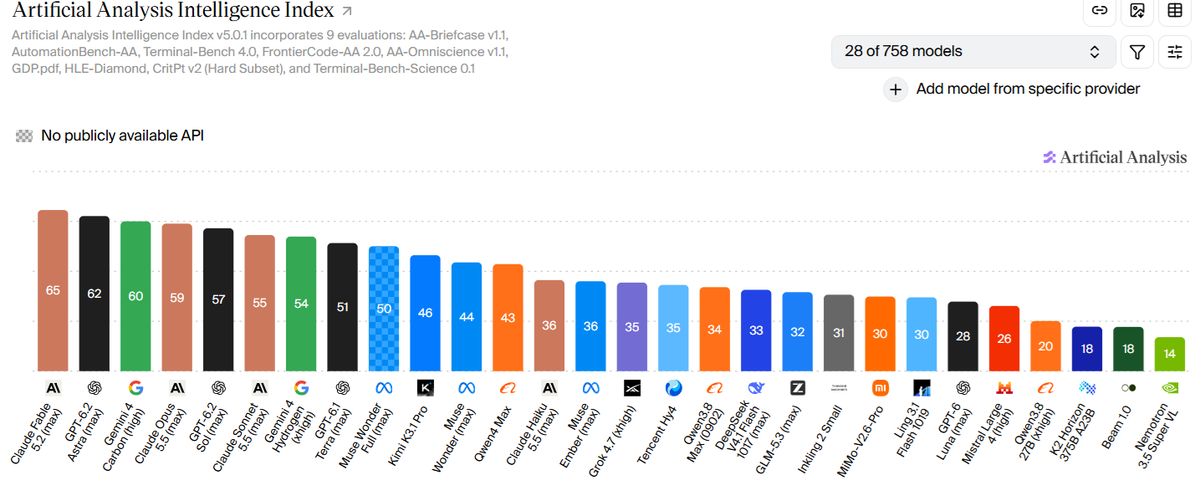
And is Claude actually the best model today? On the independent Artificial Analysis Intelligence Index, yes: Claude Fable 5.2 is #1 in the world. I put that chart in Part 10, where it does the most damage 😉
On November 5, METR, an independent AI research nonprofit, gave us the first outside measurement. METR spent about 11 weeks, August 12 to October 29, with what the AP called "unprecedented access to internal data," including internal benchmark scores, training metrics, compute, and staff interviews (METR, Nov 5; AP, Nov 5). The findings:
Anthropic is "likely improving the capabilities of their models on well-specified tasks at around twice the rate they did between March 2024 and October 2025." The central estimate is 1.9X, with a 95% range of 1.5X to 2.8X: "roughly two years of historical progress over the last year" (METR).
The cause is NOT more training compute: METR "confidently" determined the acceleration was not due to faster growth in training compute (METR). Its best guess is that "a majority (perhaps ≈80%) of the current (October 2026) acceleration is due to AI" (METR).
The limits: METR notes "AI is not yet able to make highly significant and fully autonomous contributions to the most important parts of the model training process," though Anthropic researchers see "signs of life" that it "could happen soon" (METR, quoted by AP).
That's the moat thesis in an audit report: AI helping build AI, at the lab that already leads. Now the honest caveats, because they matter. METR measured only Anthropic, so it isn't a head-to-head with OpenAI or Google. The speed-up is on well-specified tasks, not messy real-world ones. And Anthropic had redaction rights: METR says Anthropic "redacted a majority of the evidence we found most informative," to protect information that could help competitors (METR). Saying "the leader pulls away" is MY inference from METR's finding, not METR's claim. And yes, there's a tension worth naming: in a September 12 essay, Dario Amodei urged the industry to "slow the pace at which we improve the capabilities of AI models" (as quoted by AP), even as his own company is accelerating. A CEO asking the whole industry to slow down while his company leads the race is, at minimum, consistent with the safety-first structure in Part 6 🤔
Revenue grew 31X, compute 5.9X... the leader is getting MORE efficient, not less 🤯
This is what "the best model improves fastest" looks like in the S-1. In the five quarters from Q1 2025 to Q2 2026, revenue grew 31X while compute spending grew 5.9X. Revenue per dollar of compute went from $0.40 to $2.08, and revenue has outgrown compute for five straight quarters (S-1, via Exponential View, Oct 27). Now THAT is a scalable business 🤯 Annualized revenue per gigawatt of computing capacity rose 9X, from $2.6 billion to about $25 billion, with Exponential View estimating a small dip to about $24 billion in Q3 as new capacity came online. And every new generation of Nvidia chips squeezes more tokens out of every watt, so Anthropic can grow revenue faster than it adds data centers. Nobody earns more per gigawatt, which means nobody can outbid Anthropic for compute 😉
Exponential View's summary of the moat, in their words: four-fifths of Q3's revenue came from the most recent models, so every model has to win the next wave... and so far Anthropic keeps winning it. If that ever stops, we'll see it in the receipts first. Speaking of which, the receipts are coming in Part 9 😉
PART 8: WHAT IS ANTHROPIC REALLY LISTING? TITHES, NOT TOKENS... AND A SHOT AT 92% OF THE S&P 500 🤯🤔
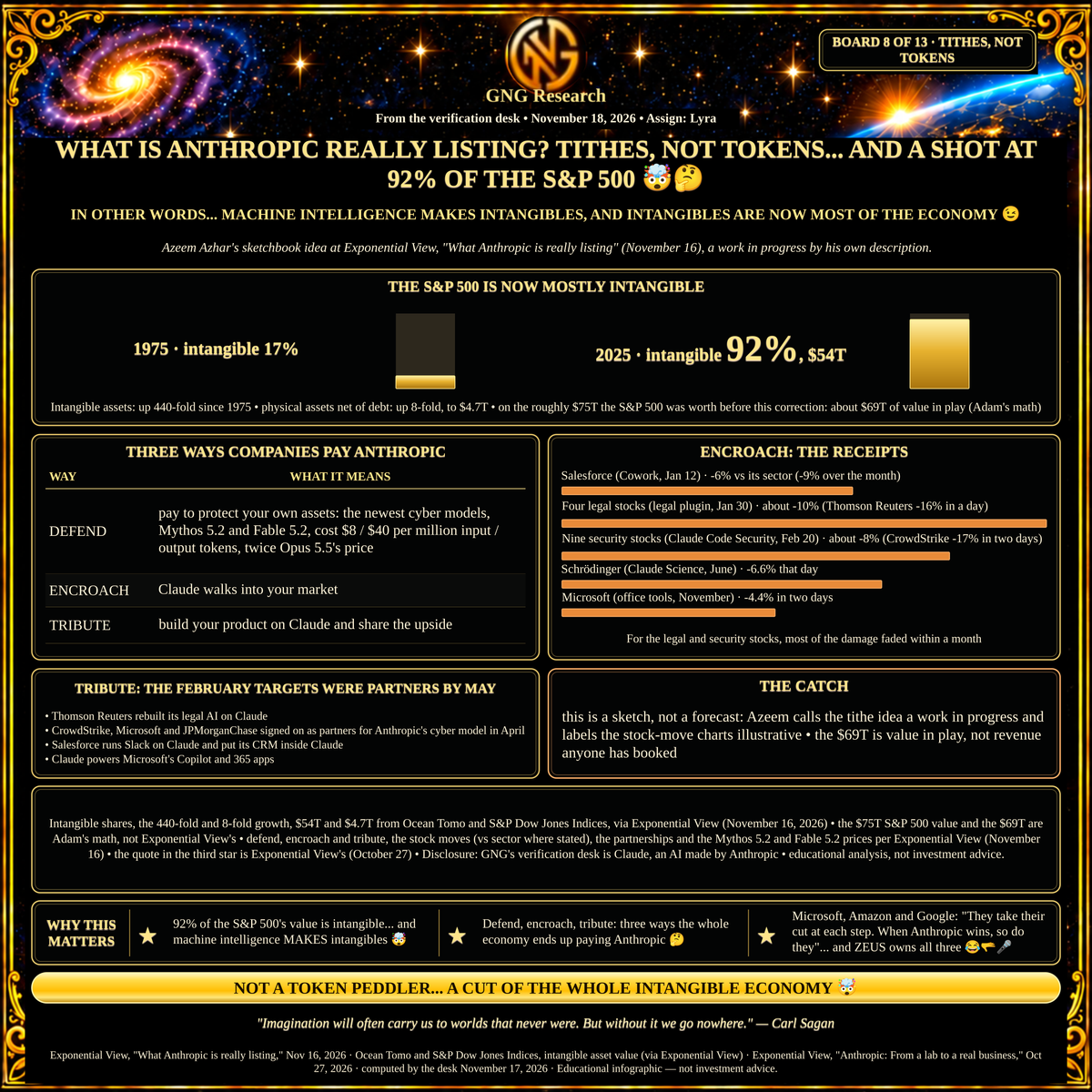
The bear case says Anthropic is "merely a peddler of progressively devalued tokens." Azeem Azhar, who runs Exponential View, says that "misses the point" ("What Anthropic is really listing," Nov 16). His sketchbook idea, still a work in progress by his own description, is the best framing of Anthropic's market I've read.
Start with what the economy is made of now. Fifty years ago, 17% of the S&P 500's value was intangible: brands, software, patents, data and know-how. By 2025 it was 92%, $54 trillion, up 440-fold since 1975, while physical assets net of debt grew 8-fold to $4.7 trillion (Ocean Tomo and S&P Dow Jones Indices, via Exponential View). The value of the world is now mostly intangible: science, code, brands. And machine intelligence MAKES intangibles. So, in Azeem's words, Anthropic "lets it compete for 92% of the value of the S&P 500 before it needs to deploy a single robot." On the roughly $75 trillion the S&P 500 was worth before this correction (my number), that's about $69 trillion of value in play 🤯
FCF/share growth consensus is 22% CAGR for the S&P (vs 6% historically), which indicates that 23% CAGR long-term returns are justified (at least for the next 3 years). SO imagine what that 92% of S&P value will become in the future!? 🤔
In 3 years, 82% growth in FCF/share = $137 trillion in value for the S&P… 92% of that is $126 trillion. THAT is the kind of addressable value that Anthropic can potentially pursue and capture a good portion of.
Azeem sees three ways companies end up paying Anthropic. DEFEND: pay to protect your own assets, because AI has exposed decades of weak software security, and the newest cyber model is the best defense, so serious companies rent it whatever the price. Anthropic's Mythos 5.2 and Fable 5.2 cost $8 per million input tokens and $40 per million output tokens, twice Opus 5.5's price. ENCROACH: Claude walks into your market. TRIBUTE: build your product on Claude and share the upside.
The receipts on "encroach" are wild. When Anthropic launched Cowork on January 12, Salesforce slid about 6% against its sector, and 9% over the following month. The legal plugin on January 30 knocked four legal stocks down about 10% (Thomson Reuters fell 16% in a day). Claude Code Security on February 20 hit nine security stocks about 8% (CrowdStrike fell 17% in two days). Claude Science in June: Schrödinger down 6.6% that day. Claude's office tools in November: Microsoft down 4.4% in two days. Six markets in nine months, though for the legal and security stocks most of the damage faded within a month (Exponential View, Nov 16; Azeem labels these charts illustrative sketches). Anthropic is literally eating the lunch of a lot of companies... which is part of why ZEUS wants to own it. Kind of like Amazon: you own the company most likely to eat your other holdings' lunch, as a hedge in case they lose the fight 😂
And then the twist: the February targets were partners by May. Thomson Reuters rebuilt its legal AI on Claude. CrowdStrike, Microsoft and JPMorganChase signed on as partners for Anthropic's cyber model in April. Salesforce runs Slack on Claude and put its CRM inside Claude. Microsoft now has Claude powering Copilot and its 365 apps (Exponential View, Nov 16). Azeem admits he went back and rewatched The Sopranos when this clicked for him. So the seven founders are like the Gambino family? 😂 Not quite. His word for it is a tithe: a permanent cut of the flow of value in an intangible economy. If he's right, Anthropic isn't just selling software... it's collecting a cut of the whole intangible economy 🤯
And I don't think there's anything unethical about encroaching on territory. Amazon kept expanding into new businesses, and the benefit to society was huge. The bad moats are the ones built on friction, like the car-dealership mafia that, by my math, costs American car buyers up to $5,000 a car—about 10% more—for no actual value. Competition that makes the product better and cheaper? That's the GOOD kind of encroaching 😉
My favorite part, as a ZEUS shareholder? Microsoft, Amazon, and Google aren't just Anthropic's partners. They're its suppliers, distributors, lenders, and shareholders. "They take their cut at each step. When Anthropic wins, so do they" (Exponential View, Oct 27). ZEUS owns all three. When Anthropic wins, ZEUS wins twice 😂🫳🎤
PART 9: TOKENOMICS 6... 85,000 BUSINESSES SHOWED US THEIR RECEIPTS, AND EVERY SECTOR, EVERY STATE AND EVERY SPENDING LEVEL IS UP 🥳🤯
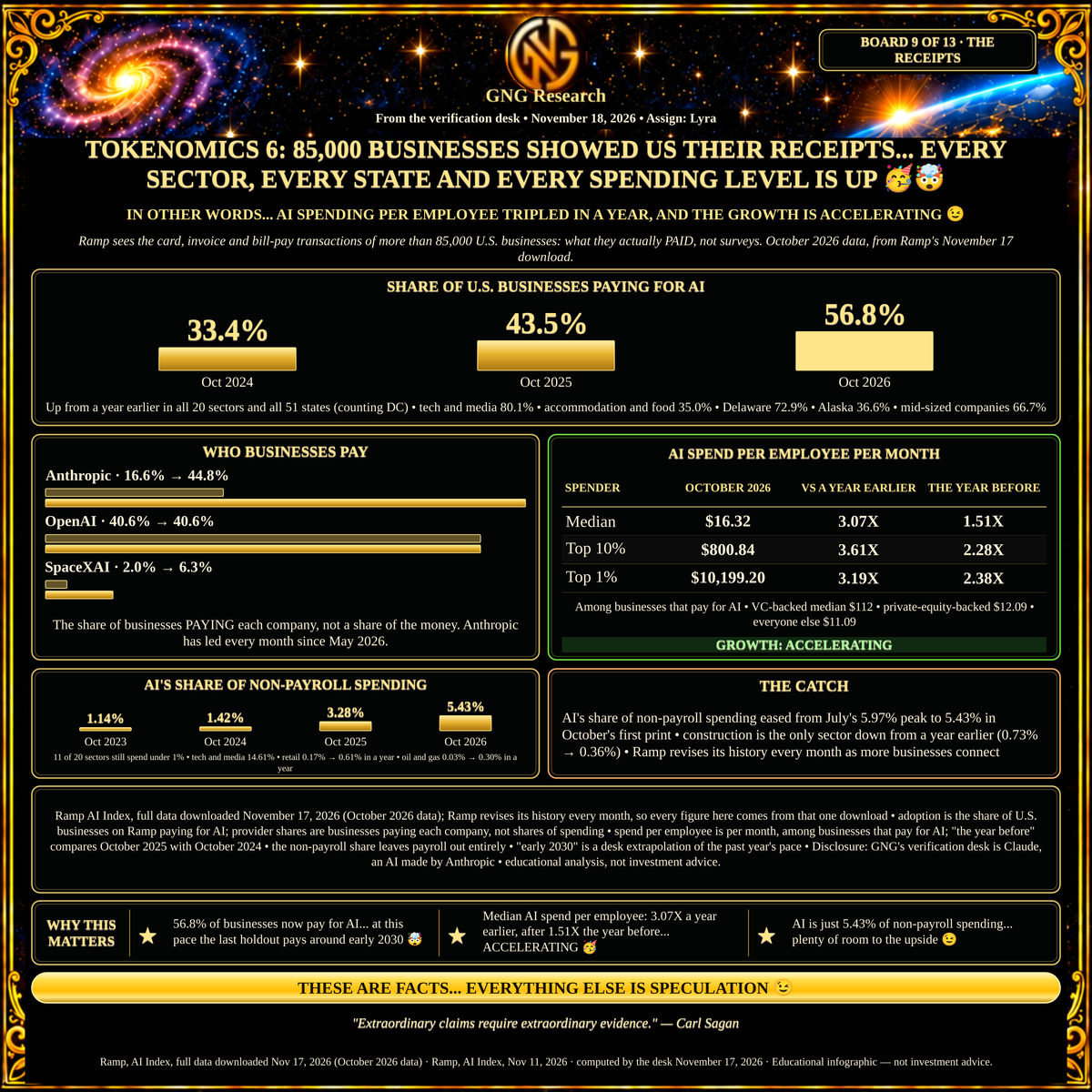
OK, Tokenomics 6 time 🥳 Ramp is now up to more than 85,000 U.S. businesses, and it sees their card, invoice, and bill-pay transactions. Direct spending data. What businesses actually PAID, which beats any survey ever taken. THIS is the definitive gold standard of AI spending data, and every month it lands like a report card for the whole AI trade. This is November's, with October data from Ramp's November 17 download (Ramp revises its history every month as more businesses connect, so every number below comes from that one download).
56.8% of U.S. businesses on Ramp now pay for AI, up 13.3 points in a year: 33.4% in October 2024, 43.5% in October 2025, 56.8% now (Ramp AI Index). At that pace, the last holdout is paying for AI in about three and a third years, around early 2030 (our math). And it's everywhere. Adoption is up from a year earlier in all 20 of Ramp's sectors and all 51 states, counting DC. Technology and media is at 80.1%, and even accommodation and food, the slowest adopter, is at 35.0%. Delaware leads the states at 72.9%, and Alaska trails at 36.6%. Mid-sized companies lead the size bands at 66.7%. Every state, every sector, every size, rising by the month. Is AI worth it to companies? These lines wouldn't be going up every month if it weren't 😉 THESE are facts... everything else is speculation.
And the race? A year ago, 16.6% of businesses paid Anthropic and 40.6% paid OpenAI. Today it's Anthropic 44.8%, OpenAI 40.6% (Ramp AI Index). The share of businesses paying Anthropic nearly TRIPLED in a year. It took the lead in May 2026 and has led every month since, adding another 1.1 points in October. OpenAI didn't shrink... It's flat. SpaceXAI is the fastest climber of the rest, up 2.2 points in October to 6.3%. Risks to Anthropic's lead? Why speculate, when every month we get FACTS? THIS is what I mean by "let the math speak" 😉 One thing to keep straight: that's the share of businesses PAYING each company, not a share of the money. For the money, we go to the token data in Part 10.
Now the spending, and this is where it gets fun 🤯 The median business that pays for AI spent $16.32 per employee per month on it in October, a new high and 3.07X a year earlier... and a year before THAT, the growth was just 1.51X. The top 10% of spenders: $800.84 per employee per month, 3.61X vs. 2.28X the year before. The top 1%: $10,199.20 per employee per month, 3.19X vs. 2.38X (Ramp AI Index). Growth is ACCELERATING at every level. Bubble, you say? Nope 😂 Anyone telling you there's a bubble in AI is either ignorant of these facts, doesn't know how math works 😉, or is trying to sell you a doomsday narrative... and sometimes it's all three at once 😂
Median spending is up from a year earlier in every business size, every sector with a year of history (15 of 15), and every state with a year of history (28 of 28). We even have it by the kind of FUNDING a company has! VC-backed companies spend a median $112 per employee per month, private-equity-backed companies $12.09, and everyone else $11.09—all up from a year ago (Ramp AI Index). "How do we know companies won't stop spending on AI?" Data like this. Asked and answered 😉 If spending slows or reverses, we'll see it in the monthly data, in monthly FACTS. In between, everything else is speculation we ignore.
Do these look like big numbers? NOPE. AI is now 5.43% of everything businesses spend outside payroll, up from 3.28% a year ago, 1.42% two years ago, and 1.14% three years ago (Ramp AI Index). And 11 of Ramp's 20 sectors still spend under 1% of their non-payroll budgets on AI. Plenty of room to the upside 😉 (By the way, these figures leave payroll out entirely, so this isn't AI money versus wages.) Where in these FACTS do you see signs of a bubble? Anyone claiming one is speculating. I'm just quoting verified spending data 😂
The sector tour, for the nerds 🖖 AI's share of non-payroll spending, from Ramp's November 17 download:
Sector | July 2023 | October 2025 | October 2026 |
All businesses | 0.77% | 3.28% | 5.43% |
Technology and media | 1.50% | 9.11% | 14.61% |
Professional, scientific and technical services | 1.04% | 7.11% | 10.94% |
Administrative support and waste management | 0.25% | 1.02% | 4.86% |
Finance and insurance | 1.33% | 1.26% | 4.51% |
Management of companies | 0.26% | 0.57% | 2.21% |
Real estate | 0.27% | 0.71% | 1.51% |
Health care | 1.04% | 0.80% | 1.23% |
Manufacturing | 0.30% | 0.81% | 1.22% |
Education | 1.11% | 0.74% | 1.19% |
Arts, entertainment and recreation | 0.06% | 0.24% | 0.77% |
Transportation and warehousing | 0.38% | 0.29% | 0.62% |
Retail | 0.43% | 0.17% | 0.61% |
Wholesale trade | 0.07% | 0.24% | 0.49% |
Construction | 0.06% | 0.73% | 0.36% |
Accommodation and food services | 0.04% | 0.25% | 0.33% |
Utilities | 0.46% | 0.15% | 0.32% |
Other services | 0.42% | 0.23% | 0.31% |
Public administration | not tracked yet | 0.21% | 0.30% |
Mining, quarrying, and oil and gas | not tracked yet | 0.03% | 0.30% |
Agriculture, forestry, fishing and hunting | 0.23% | 0.13% | 0.26% |
Waste management went from 0.25% to 4.86%. Oil and gas went from 0.03% to 0.30% in ONE year. Does 3% next year sound crazy? See what I mean by plenty of upside? Retail more than tripled in a year, right when agents got good enough to automate the scut work. Humans were never meant to do that work, and NO ONE wants to, so that one's 100% benefit. Finance more than tripled as AI agents got useful and reliable. Education experimented early with clunky AI, backed off, and is back near its record. Wholesalers hit a record 0.49%, about 1/200th of what they spend. Restaurants, 0.33%. "Other services" (not exactly sure what that catch-all actually means 😂) went from 0.23% to 0.31%. Public administration, one of the least efficient corners of the economy, was 0.30%. In one year, two years, three years, do you REALLY think these numbers will be lower, with AI getting dramatically better every year? 🤔 One honest exception: construction is the only sector whose AI share fell from a year earlier, from 0.73% to 0.36%, after a 2025 spike. Even there, it's up about 6X since 2023.
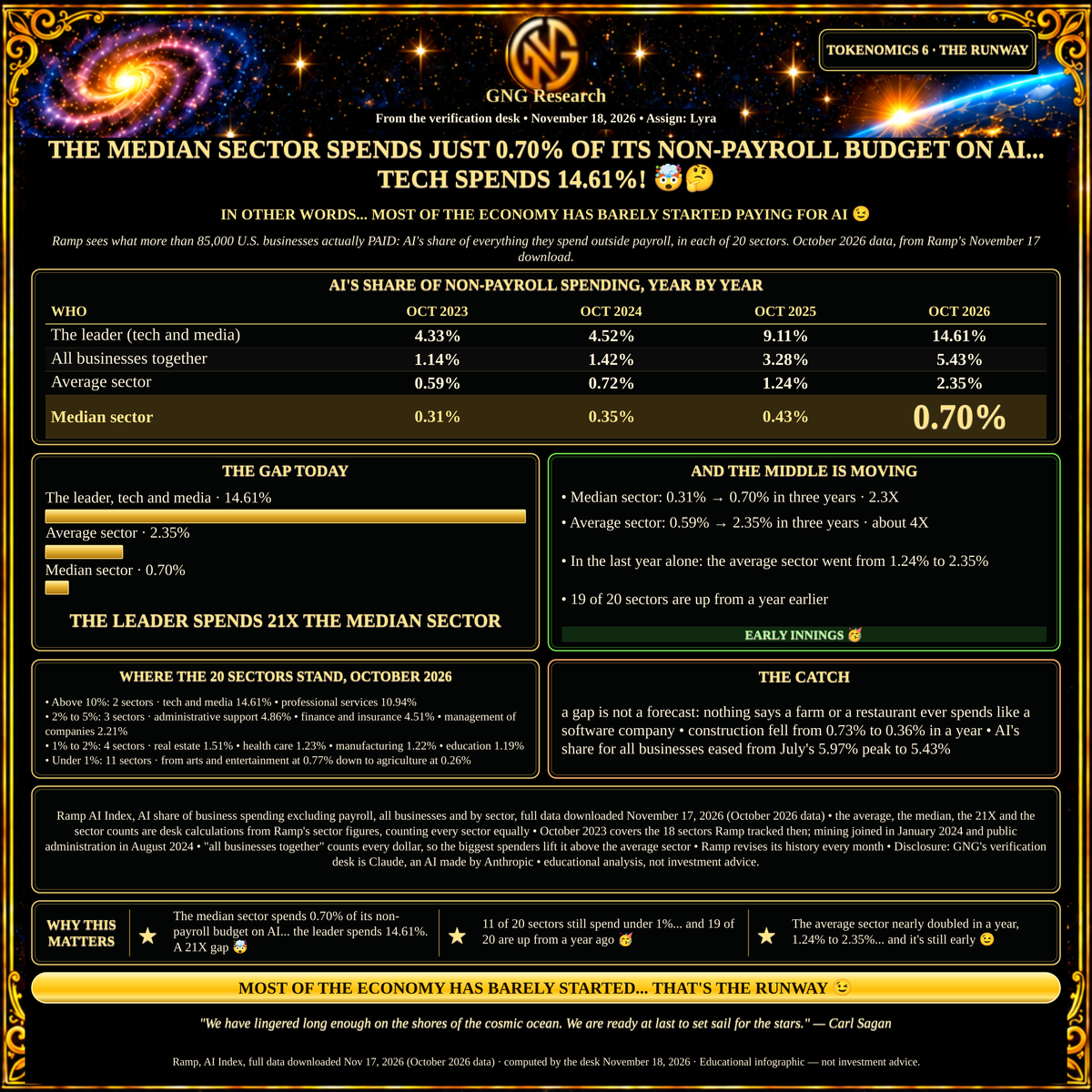
“It's 9:00 PM at a party that goes until 4:00 AM” — Danny Ives, Wedbush Securities
With respect to Mr. Ives, the time might be 9 PM at this AI party, BUT the data is saying this is a party that will never stop🤔😂
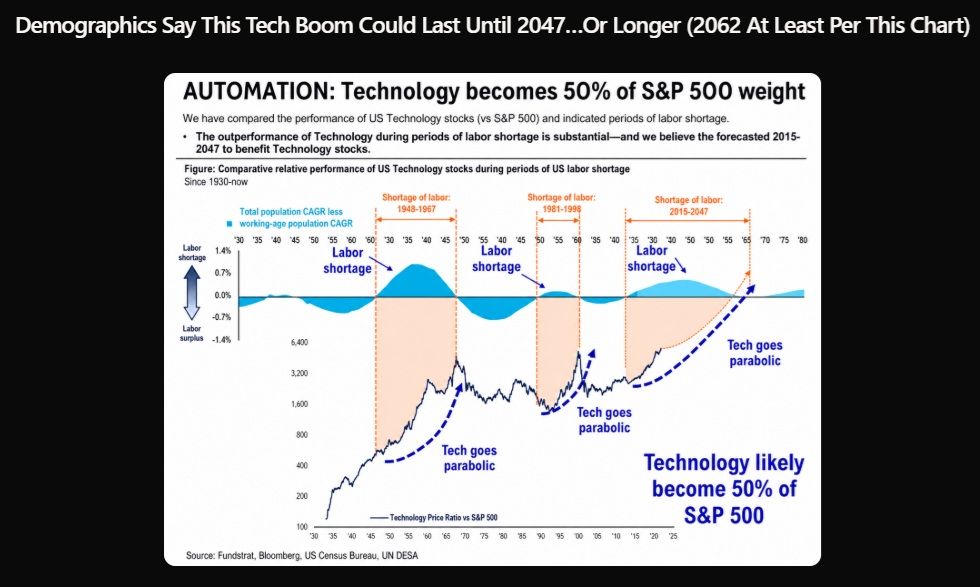
Remember that I would rather be right than sound smart…or seem sane😂…because only one of those makes you rich🤔
Sign in to leave a comment and join the discussion.
Sign Up Free