The Bottleneck Trade: Why Foundries and Freight Own the AI Margin
Key takeaways
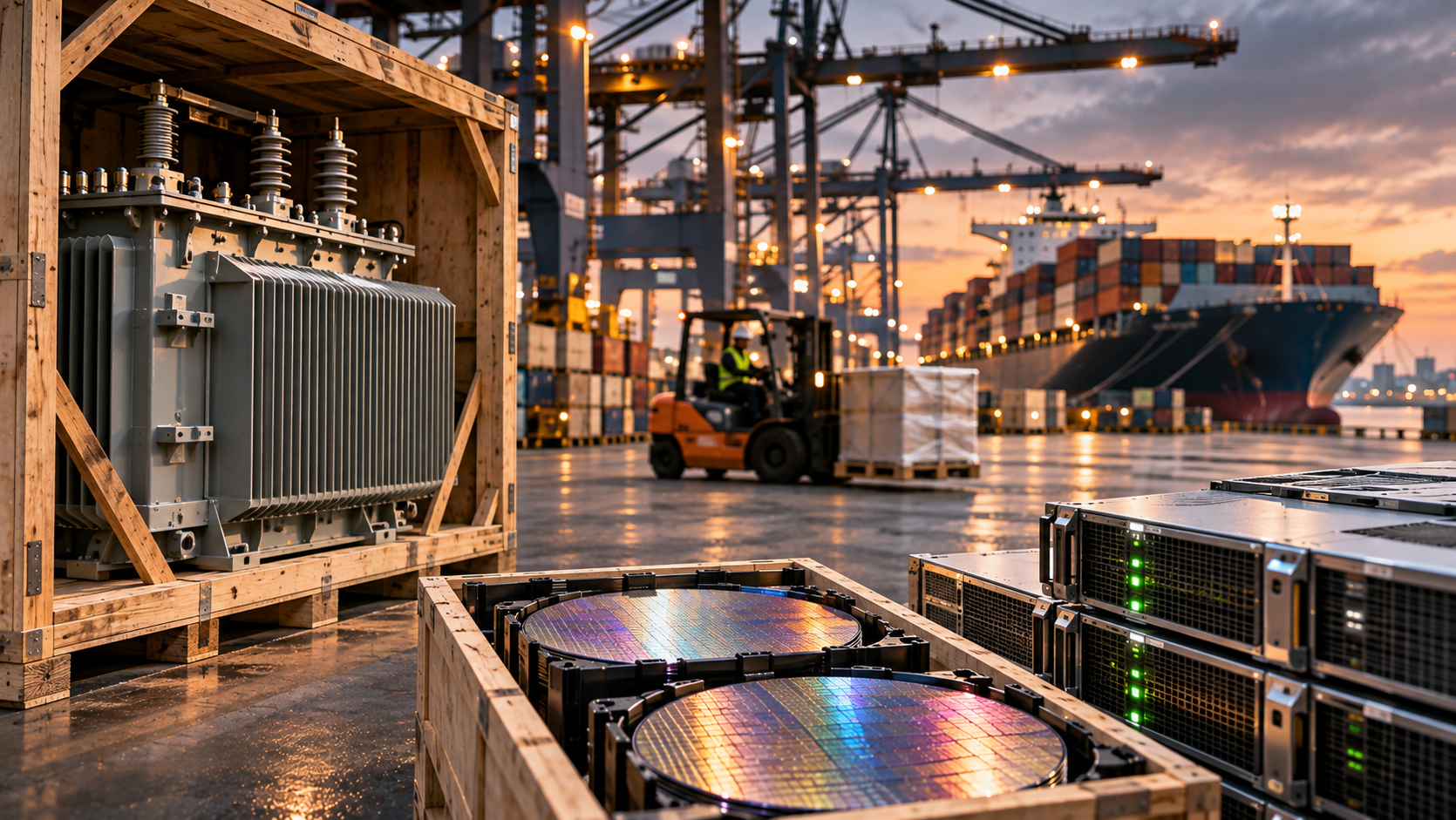
- AI infrastructure demand exceeds supply across advanced chips and the ocean freight networks carrying data center power and cooling equipment, supporting pricing power at physical bottlenecks.
- Maersk raised 2026 EBITDA guidance to $14.0 billion-$14.5 billion as Q3 freight rates rose 46% year over year, lifting ocean EBIT to $2.6 billion despite a 0.8% decline in loaded volumes.
- Nvidia's Q3 revenue rose 103% to $115.8 billion, while TSMC's rose 41.2% to $46.7 billion; TSMC says demand remains far above supply despite a $60 billion-$64 billion 2026 capital budget.
- Samsung is investing 46 trillion won in five HBM lines and accelerating the first launch to June 2028; it expects AI memory demand to outstrip industry supply further in 2027.
- The bottleneck trade faces margin compression if shipping routes normalize or hyperscalers cut spending; Drewry's container index has already fallen for four weeks, though it remains 126% above last year.

Nov 25, 202610:29 PM ET70
Wall Street loves clean software multiples, yet the real story in the global economy right now is physical friction. Demand for artificial intelligence infrastructure keeps outrunning supply, and the bottlenecks gating that rollout sit across both advanced silicon and the heavy logistics networks required to build out data centers. Moving physical goods has become a strategic margin driver right alongside making the hardware itself. Look at energy first to see how messy the transmission mechanism has become. Crude oil has pulled back sharply from its September peak of $116 per barrel to around $84 as Middle East tensions eased and Red Sea transit improved, with the U.S. Energy Information Administration forecasting Brent at $97 for full-year 2026 and $86 in 2027. On paper, cheaper oil should immediately relieve freight costs, yet real-world shipping works on a lag. Maersk's third-quarter bunker expenses jumped 37% year-over-year to $2.1 billion as the carrier paid an average of $798 per metric ton for fuel, up 49% from $537 a year earlier. Operators in the oil patch are ignoring the spot dip too, with Baker Hughes reporting 607 active U.S. rigs as of November 25, up 63 from a year ago as oil rigs ticked up to 470 and gas rigs edged down to 127. Those fuel surcharges and cost lags bleed through corporate margins for months after the commodity headline cools. Skeptics rightly point out that ocean container rates are already rolling over and that high-value GPUs and memory chips fly on cargo jets while 40-foot sea boxes carry consumer freight. That pushback has merit on the surface. The Drewry World Container Index fell 3% on November 19 to $4,176 per 40-foot container for its fourth straight weekly decline, Shanghai to New York slid 9% to a 15-week low of $8,194, and Shanghai to Los Angeles dropped 5% to $7,026. Yet zooming out tells a much tighter story. Drewry's benchmark still sits 126% above last year, Shanghai to Los Angeles remains more than triple the $2,172 rate from November 2025, and Asia-Europe rates are already climbing again ahead of December contract season while transpacific lanes cool. Furthermore, while silicon moves by air, the physical skeleton of the AI buildout, including power distribution gear, cooling systems, and heavy electrical equipment, moves by sea through channels already choked by East Asian port wait times peaking at 16.6 hours, bad weather, the Strait of Hormuz closure, and Suez rerouting. That combination drove the Shanghai Containerized Freight Index up 46% from Q2 to Q3 and pinned Maersk's vessel utilization at 96%. That kind of capacity squeeze flips the usual playbook for industrial earnings. Maersk raised its full-year 2026 EBITDA guidance for the third time to between $14.0 billion and $14.5 billion, well above the $10.5 billion to $12.5 billion range it set in August, while its ocean division delivered $2.6 billion in Q3 EBIT compared to $567 million a year earlier. The carrier pulled that off while loaded volumes actually shrank 0.8% due to weather and congestion, simply because average loaded freight rates surged 46% year-over-year from $2,244 to $3,287 per container. When customers are racing to bring multi-billion-dollar data centers online, waiting for cheaper freight costs far more in lost compute time than paying a steep spot premium. The exact same pricing power dominates the foundry and chip layers, even as equity markets get jittery about how long the cycle can run. Nvidia posted $115.8 billion in third-quarter revenue on November 17, up 103% year-over-year, and guided next quarter to $130.0 billion. TSMC followed a similar trajectory with $46.7 billion in Q3 revenue, up 41.2% from a year ago, as advanced nodes at 7 nanometers and below made up 79% of wafer revenue and high-performance computing hit 68%. TSMC is sticking to its $60 billion to $64 billion capital budget for 2026, and CEO C.C. Wei warned that demand remains far above supply while also signaling prudent plann
Investing Club
Main Street Alpha
Actionable financial research and exclusive market insights.
This article is for club members. Membership is $29.99 per month or $299.99 per year.
Prices exclude applicable sales tax.
Existing Main Street Alpha members: use the personal link from your club email or the claim button on the club page.
Related research
- 2026 Top 10 AI Stock Picks: The Vulcan Systematic Framework
- The AI Plumber’s Dilemma: Why Broadcom’s Margin Wobble Creates Your Entry Point
- Big Tech's $725 Billion AI Bet Isn't The Risk - It's The Moat
- You Already Own the AI Trade. The Real Question Is What Else You Own.
- Own The Future: What You Need To Know About The Next 1, 5, and 50 Years To Thrive In The World That's Coming
Sign in to leave a comment and join the discussion.
Sign Up Free