
HAPPY THANKSGIVING!
Introduction
I have to admit that options are the one corner of the market I have mostly left alone. And I honestly doubt that comes as a surprise to many, as my strategy is straightforward: I spent most of my time finding the best investments. I buy them. Then, I leave them alone. As simple as that.
That said, I know the basics. I know what a call is, what a put is, and why people sell them. I know more than that, but you get my point. But I have never made options a part of my own strategy, mainly because I don't need the income.
Many of you do - and even those who don't may want to have the tools for it.
As always, we're all in a different spot. Some of you are still building wealth. Some of you live off your portfolios. And quite a few of you have been using options for years.
One of them is Nate, who uses options a lot and has been kind enough to share his approach in the comment section for a long time. His comments (and his support) gave me the push to finally do this the right way. So, thank you, Nate!
In this article, I'll build the covered call from the ground up. I'll explain what it is, where the "income" comes from, what it costs, and in which situations it makes sense. I'll also run the numbers on three stocks I own, discuss the retiree case, and explain when a covered call ETF is the better tool.
This is an educational piece for me as much as it is for you. I learned a lot while working on it.
That said, I have one request before we start. I don't want anyone to become an active trader because of this article. Please treat everything below as a foundation you can apply to your own portfolio (if it fits at all).
So, as we have a lot on our plate today, let's dive right in!
What A Covered Call "Really" Is
Let's start with a house - you know I like to keep it simple.
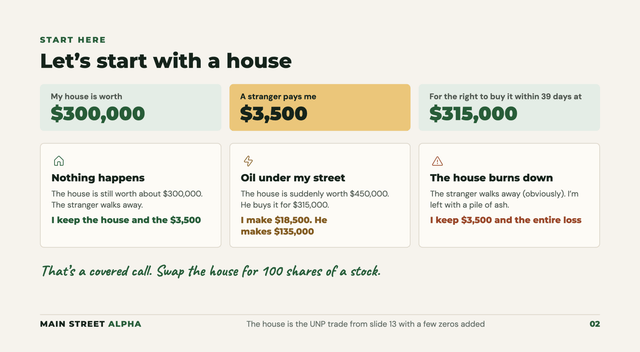
Imagine you own a house worth $300,000. A stranger knocks on your door and offers you $3,500 in cash. In return, he wants the right to buy your house for $315,000 at any point in the next 39 days.
You take the money. Now, three things can happen.
Nothing happens. The house is still worth roughly $300,000. The stranger walks away. You keep the house and the $3,500.
Someone finds oil under your street. The house is suddenly worth $450,000. The stranger buys it for $315,000. You keep the $3,500 and get to watch him make $135,000.
The house burns down. The stranger walks away (obviously). You keep the $3,500 and have no house.
That's a covered call.
Swap the house for 100 shares of a stock and the stranger for an option buyer. A call option gives its buyer the right to buy 100 shares at a fixed price (the "strike") until a fixed date (the "expiration"). The cash he pays you is the "premium." And the trade is "covered" because you already own the shares you may have to hand over.
If the buyer exercises his right, your shares leave your account, and the cash arrives. This is called "assignment," and your broker handles it automatically. If he doesn't, the option expires worthless, and you're free to sell a new one.
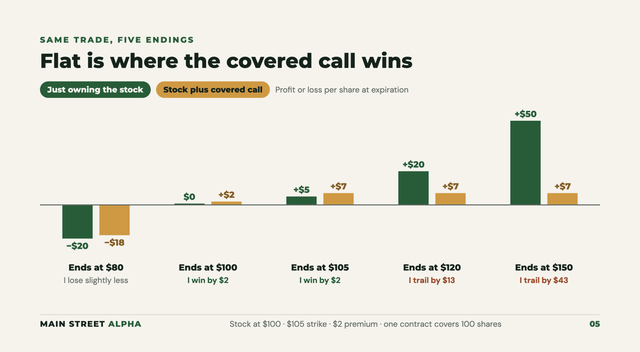
Let me put simple numbers on it. Say a stock trades at $100, and I sell a one-month call with a $105 strike for $2 per share.
Stock price at expiration | Just owning the stock | Stock plus covered call |
$80 | -$20 | -$18 |
$100 | $0 | +$2 |
$105 | +$5 | +$7 |
$120 | +$20 | +$7 |
$150 | +$50 | +$7 |
Profit or loss per share. One contract covers 100 shares.
This table tells you almost everything you need to know.
The downside is still mine. If the stock falls 20%, I lose 18%. The premium is a small cushion and nothing more.
The upside is capped. My best case is 7pershare(5 to the strike plus the $2 premium), no matter how high the stock goes.
Flat is where I win. If the stock goes nowhere, I make $2, and the regular shareholder makes nothing.
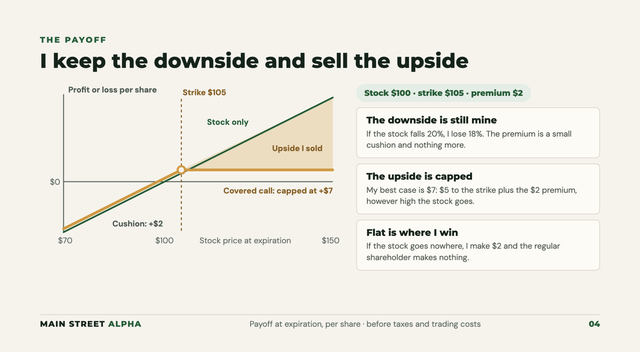
What I'm getting at is that a covered call changes the shape of my returns. I trade an open-ended upside for a small payment I get right away.
Note that this is often abused by online "gurus." I have seen many promotional videos where these people sold courses. They showed people that there's a tool to generate cash whenever they need it. That included getting gas for their car. They quickly did a transaction and had the cash to pay for it.
Easy, right?
Obviously, they didn't tell people what they were getting into, as these tools come with risks as well. As we just discussed, the upside is capped, while the downside is still there.
And there's more to it.
Sign in to leave a comment and join the discussion.
Sign Up Free