
Editor's Note (November 4, 2026)
I wrote this article before Tuesday's U.S. midterm elections. Democrats have since won control of both the House and the Senate, and Texas elected a governor who campaigned on a moratorium on new data centers.
I'm not going to comment on the politics. But I do need to flag the market reaction, as it played out along the exact lines of this article.
On Wednesday, the Dow rallied more than 2%, and Microsoft (MSFT) touched a record high. At the same time, the AI build-out got hit hard. CoreWeave (CRWV) fell roughly 9%, GE Vernova (GEV) roughly 10%, Constellation Energy (CEG) roughly 9%, and Vistra (VST) roughly 14%.
Think about it: investors sold the companies that need to build, borrow, and plug in, while the hyperscalers that already own their data centers held up. That's my "Who Funds The Build-Out Decides Who Gets Hurt" section playing out in real time.
Three quick thoughts before you dive in:
Politics is now part of the power gate. Power bills were already a hot topic. On Tuesday, at least 10 communities also approved bans or restrictions on data centers, and Texas is home to roughly a quarter of planned U.S. data center capacity, according to one large bank.
Don't overreact. The new Congress doesn't sit until January. Any federal bill would need the president's signature or a veto override, and most data center decisions are made at the state and utility-commission level.
GEV just got cheaper. Only about 20% of its contracted gas turbine capacity served data centers as of midyear. I still wouldn't buy it in one go. Tranches remain the way to go.
One more thing. In the Takeaway, my first risk is that bottlenecks clear faster than expected, for example, through faster permitting. After Tuesday, I'd say that risk just got smaller.
The rest of the article is unchanged.
Introduction
I have to tell you something. I thought about writing this article for more than a month. I just wasn't sure of how to approach this topic, and I was even less sure if I was able to get my point across in a way that could help you in your investment process.
That thought process has finally turned into an article, based on my Big Picture process that asks questions like the one below.
What happens when the most important technology of our lifetime runs into the oldest constraints in the world: steel, copper, natural gas, and borrowed money?
As many of you know, I'm very bullish on AI. I call it a revolutionary technology, and I mean it.
But I've also been very vocal about bottlenecks. In my view, the most interesting part of AI is the physical world behind the chatbot on your screen.
Last week, two documents sharpened that view more than anything I've read in months, which is what finally got me to publish the article you're reading right now.
The first is the S-1 Anthropic (not yet listed) filed on October 26 ahead of its IPO. First-half revenue came in at $16.3 billion, up from $1.2 billion a year earlier. If any company had a reason to sound unconstrained, it's this one.
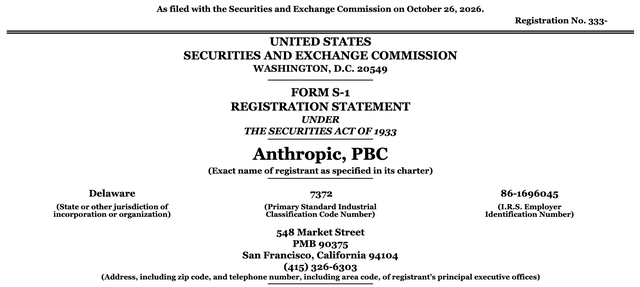
Yet its risk factors (part of any S-1) read like an energy filing. Transformers. Turbines. Pipelines. Electricians. You know the drill.
The second is a short note from Torsten Slok, who is the chief economist at Apollo Global Management (APO), with a blunt title: "No Signs of AI Payoff Outside the Tech Sector."
Put those two together, and you get my thesis.
AI is happening. But it will happen at the speed of its slowest input. Right now, the slowest inputs are power, credit, and broad adoption outside of tech.
That's fine for AI as a technology. It's a problem for companies priced as if the road ahead has no speed limit. I'm talking about semiconductor stocks valued on peak margins and AI cloud providers financed with junk-rated debt.
In this article, I'll walk you through the four "gates" AI has to pass through, what the credit market is telling us, why chips sit at the dangerous end of the "bullwhip," and a playbook with specific ideas for income investors, growth investors, tech investors, and those with a higher risk appetite. And I'll end with a twist that changed how I think about this cycle.
So, let's dive in!
The Four Gates Of AI
If I had to explain this to the fictional 16-year-old with a short attention span, imagine a four-lane highway that suddenly narrows to one lane at a bridge. Traffic still gets across, just slower.
Who does well? The owner of the bridge, who collects a toll on every car. Who does badly? The car dealer who forecast next year's sales assuming four lanes all the way.
The AI build-out has four of these bridges, or gates:
Chips: Can we make enough accelerators and memory?
Power: Can we plug them in?
Credit: Can we pay for all of it?
Adoption: Will enough customers pay enough to make it worth it?
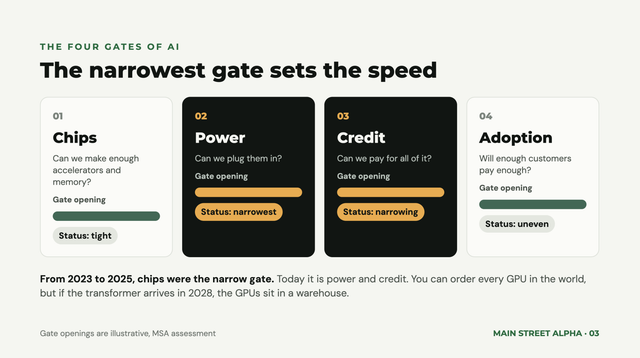
From 2023 to 2025, the narrowest gate was chips. That has changed. Chips are still tight, but power and credit have become narrower. That's a fancier way of saying that companies are buying chips they cannot use because there's no power. Now, adoption is quietly joining them.
Obviously, the build-out can only flow as fast as the narrowest gate allows. You can order all the GPUs in the world, but if the transformer arrives in 2028, the GPUs sit in a warehouse.
Gate 2: Power, In AI's Own Words
IPO risk factors are written very carefully, because getting them wrong can lead to lawsuits. You cannot imagine how much time highly paid lawyers spend on this stuff, especially for trillion-dollar IPOs. So, when one of the most important AI companies in the world writes this, I pay attention:
The availability of sufficient electrical power has emerged as a significant constraint on data center development and expansion in many geographies, including the United States. Electrical grid infrastructure in the United States and other countries was not designed to accommodate the rapid increase in demand associated with AI development, and the lead times required to build new generation capacity, transmission infrastructure, and grid interconnections can extend for years. - Anthropic, PBC S-1
The filing goes on to list "high-voltage transformers, switchgear, turbines, generators, substations, and transmission components" as subject to "extended delivery timelines." It even mentions shortages of electricians.
The external data backs this up:
GE Vernova (GEV) ended 3Q26 with 122 GW of gas turbine backlog and slot reservations, and expects at least 130 GW by year-end. New buyers are looking at delivery dates in the early 2030s.
Standard power transformers take two to three years to deliver.
BloombergNEF counts 74 GW of announced on-site gas capacity for data centers. The grid itself can connect roughly 10 GW of new data center demand per year. Think about that for a second!!
One major investment bank expects only 50% to 60% of planned data center capacity to come online within two years.
Oracle (ORCL) invoked force majeure (a clause excusing performance due to events outside its control) on its 2.5 GW New Mexico campus after regulators blocked a gas pipeline.
And the bills are showing up (imagine that). Wholesale power in PJM, the largest grid market in the U.S., averaged $136.53 per megawatt-hour in 1Q26, up roughly 76% from $77.78 a year earlier. PJM's market monitor blamed data center demand.
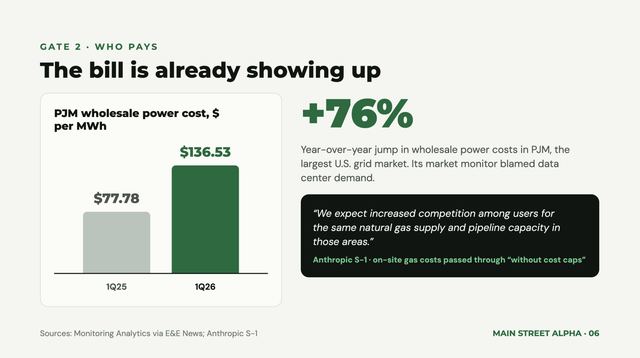
As someone who has written about "Physical Stagflation" for years, this next part fascinated me. The S-1 explains that some planned facilities rely on on-site gas generation, with fuel costs passed through "without cost caps." It then says:
As data center operators increasingly rely on natural gas-fired generation [...] we expect increased competition among users for the same natural gas supply and pipeline capacity in those areas. - Anthropic, PBC S-1
The most advanced software companies on Earth are now competing for pipeline capacity. That is the physical economy setting the speed of the digital one.
Sign in to leave a comment and join the discussion.
Sign Up Free