
The Charge That Sticks
Al Capone ran bootlegging, gambling, and a body count that made him the most famous criminal in America.
He went to prison in 1931 for tax evasion.
It's one of the oldest lessons in history: the charge that brings someone down is rarely the thing that matters most. It's just the thing that could be proven, or the thing people could understand, or the thing that made the best headline.
Keep that in mind when you read about Jensen Huang.
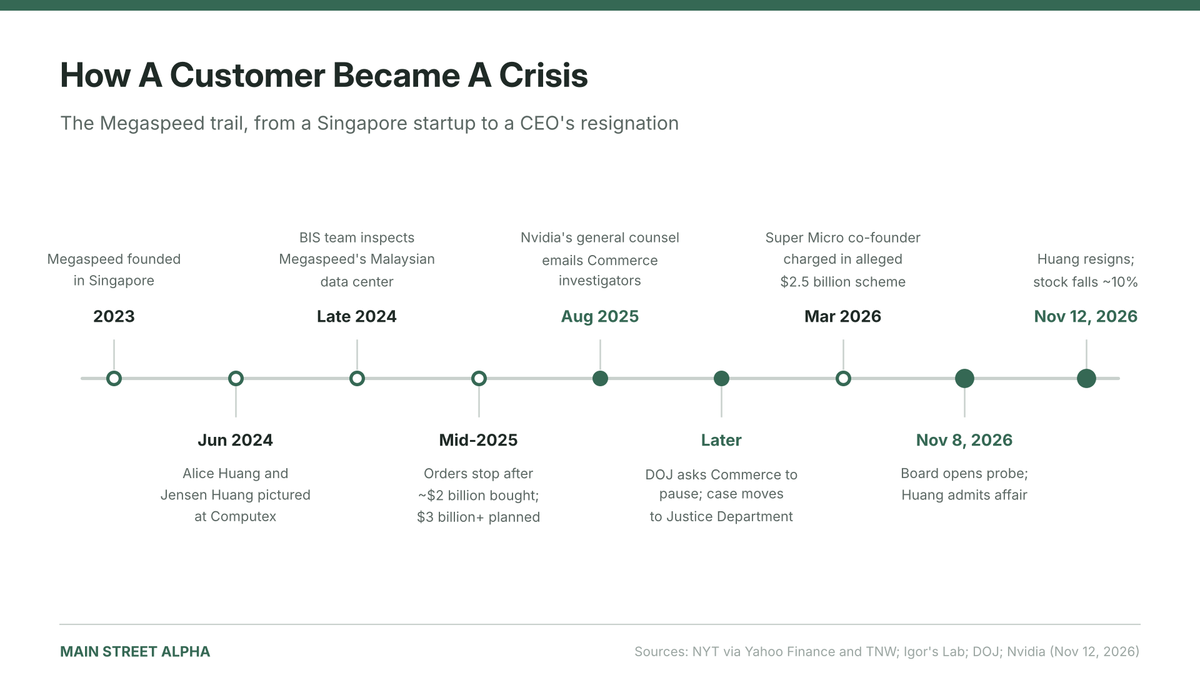
On Thursday, Nvidia (NVDA) announced that Huang had resigned as president, CEO, and board member, effective immediately. He co-founded the company in 1993 and ran it for 33 years. His exit followed reports of extramarital affairs, including one with a woman U.S. intelligence officials reportedly believe was working for Beijing.
CFO Colette Kress is now interim CEO and will stay on as CFO. Director Harvey Jones became the company's first-ever board chair. A search for a permanent CEO is underway. The stock fell nearly 10%.
Before we go further, I want to point you to the work of my friend and colleague Connor Graham. Earlier this week, he published "Nvidia's 30% Crash: How The Data Points to a Comeback," a deep look at every major Nvidia sell-off since 2010. His findings are hard to ignore. Nvidia has fallen 25% or more eight times in that period, and it went on to surpass its prior peak every single time. Seven of those recoveries took less than 14 months from the bottom.
If you're looking at the stock, I'd read his piece first.
This article offers a different perspective. It doesn't make a call on the share price. It looks at the parts of this story that a price chart can't capture: the customer list, the invoices, and the enforcement system around them. Both views can be true at the same time. A great company can recover, and still have questions worth asking.
The headlines say it was an affair.
The invoices tell a more interesting story.
Read The Customer List
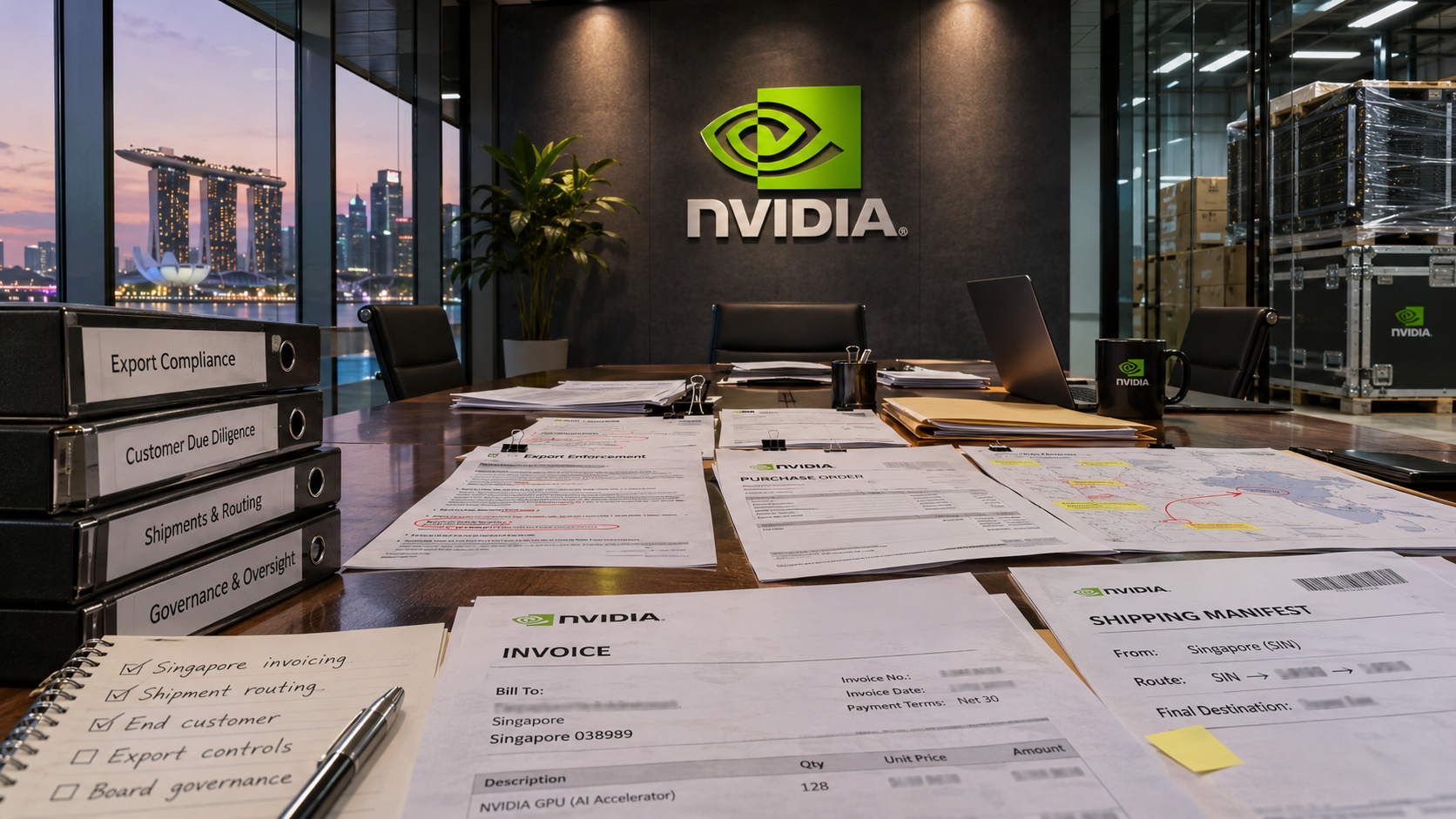
The woman is Alice Huang (no relation). She was a top executive at Megaspeed, a Singapore company founded in 2023 that quickly became one of the more aggressive buyers of Nvidia hardware in Asia.
How aggressive? Megaspeed reportedly bought around $2 billion of Nvidia equipment, routed through Aivres, the California subsidiary of Chinese server maker Inspur. It ran data centers in Malaysia and Indonesia. More than $3 billion in additional systems were reportedly planned before orders stopped in mid-2025. Alice Huang and Jensen Huang were photographed together at Computex in 2024, after a multibillion-dollar purchase.
U.S. intelligence officials reportedly concluded she was gathering information for China. Beijing calls that a smear. Megaspeed denies smuggling chips and says it's cooperating. The Justice Department is reportedly running a criminal investigation into the company.
Here's what's important to say clearly: no report so far says Huang handed over designs or secrets. Nvidia's board said it had "no reason to believe" national security or company secrets were compromised.
But boards don't need a leaked blueprint to act.
They need a paper trail they can't explain away. And this one connects the CEO of the most valuable chip company in the world to the executive of a multibillion-dollar customer that U.S. officials say had a line to Beijing, while that customer was under federal investigation for diverting chips to China.
When those facts sit in the same file, an affair stops being a private matter. It becomes a governance problem.
The $23.7 Billion Line Item
Now zoom out, because Megaspeed isn't the only interesting thing about Singapore.
In fiscal 2023, Nvidia billed $2.3 billion of revenue to customers in Singapore. Two years later, in fiscal 2025, that number was $23.7 billion. That was 18% of the company's total revenue, making a city-state of six million people Nvidia's second-largest billing location after the United States.
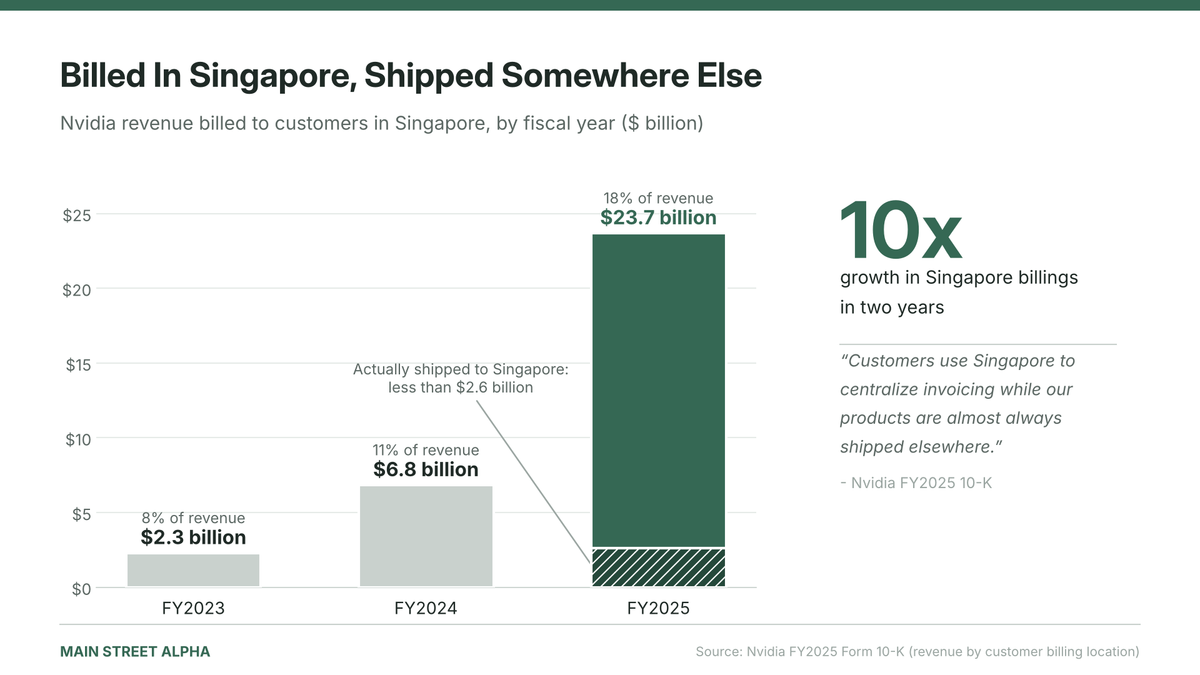
Then there's the sentence in Nvidia's own annual report that explains it: customers use Singapore "to centralize invoicing while our products are almost always shipped elsewhere." Shipments to Singapore were less than 2% of revenue.
There's a perfectly normal explanation for most of that. Big companies route invoices through Singapore all the time. It's a tax-efficient, well-run hub. Most of the $23.7 billion is probably exactly what Nvidia says it is.
But think about what that structure means in practice. For a big chunk of its revenue, the company knows who paid, but not, from the invoice alone, where the chips ended up.
That's fine when everyone trusts the buyers.
It's a different conversation when one of those buyers is under a criminal investigation, and the CEO was personally close to its executive.
On a side note: Nvidia has since changed how it reports geography. Since its third fiscal quarter of 2026, revenue is assigned by where customers are headquartered rather than where they're billed. The Singapore line no longer appears in the filings.
The Dead Man's Switch
A train has a device called a dead man's switch. If the operator lets go, because he passes out or is gone, the brakes engage on their own. The system is designed to keep working even when a person stops doing their job.
A former head of Export Enforcement at the Commerce Department's Bureau of Industry and Security (BIS, the office that enforces chip export rules) says he built one.
His account of 2025 goes like this. Billions of dollars in illegal chip exports. Billions more flowing through front companies in Southeast Asia. And a chain of command that, in his telling, didn't want any of it landing on Nvidia. He claims Under Secretary Jeff Kessler wanted to keep Nvidia from looking like the center of the problem, and that Commerce Secretary Howard Lutnick viewed the company as too important to damage, especially with Beijing threatening to cut off rare earths and magnets.
Those are his claims. Commerce hasn't confirmed them, and says it handled the Megaspeed case "strictly by the book."
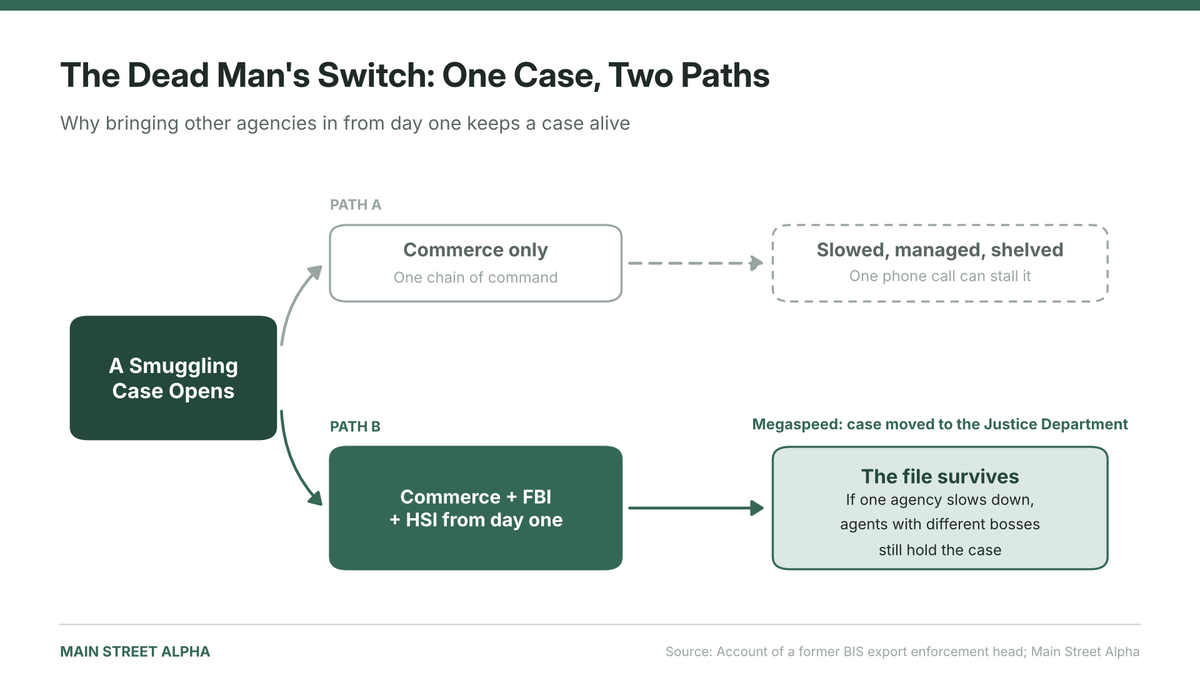
His workaround was simple. Bring the FBI and Homeland Security Investigations into every case from the very beginning. If one agency slowed a file down, agents with different bosses would still be holding it.
Here's where his story and the public record meet.
According to The New York Times, Nvidia's general counsel emailed Commerce investigators about the Megaspeed probe in August 2025, writing that Kessler had given him permission to reach out. The investigators declined to meet and forwarded the emails up the chain. Kessler reportedly told them to follow procedure strictly. The Justice Department then asked Commerce to pause its work, and the case moved to DOJ.
To be fair, the Times also reported there's no evidence Kessler ordered investigators to stop, or that Nvidia changed the outcome. Nvidia says it routinely talks to officials to help stop smuggling while protecting legal sales.
But look at where the case ended up. Not in a drawer at Commerce, where it could be managed and delayed. At the Justice Department, where it became a criminal investigation. That's the dead man's switch doing exactly what it was designed to do.
And it isn't the only file that survived. In March 2026, federal prosecutors charged three men, including a Super Micro Computer (SMCI) co-founder, over an alleged $2.5 billion scheme to ship Nvidia-powered servers to China.
Meanwhile, the Times reported that Commerce hasn't added a single company to its Entity List (the government's export blacklist) in more than a year, the longest stretch in 18 years.
Why This Matters More Than The Man
It's tempting to think the story ends with Huang's resignation. The person at the center is gone. Case closed.
But scandals rarely work like that. The person is the headline. The system is the story.
Huang built one of the greatest companies of our time. That doesn't change. What changes is that the questions now point at institutions, not personalities:
Who at Commerce knew what about Megaspeed's purchases, and when?
Did anyone above the agents ask for cases to slow down because of Nvidia's exposure?
With the CFO running the company and DOJ examining a major Singapore customer, how much of what Nvidia booked over the last three years will auditors want to look at again?
None of these has an answer yet. That's the point. Markets are good at pricing things they can see. They're much worse at pricing questions that won't be answered until a subpoena answers them.
Nvidia reports earnings on Tuesday, November 17. It will be the first call in the company's history without its founder.
In the end, a team of Treasury accountants did more damage to Capone than any rival gang ever did.
Huang's affair made the headlines. But if this story keeps going, it'll be because someone followed the invoices.
Sign in to leave a comment and join the discussion.
Sign Up Free